Your vehicle may have cost $20,000, $40,000, $60,000, or more when it was new.
But what is it worth now?
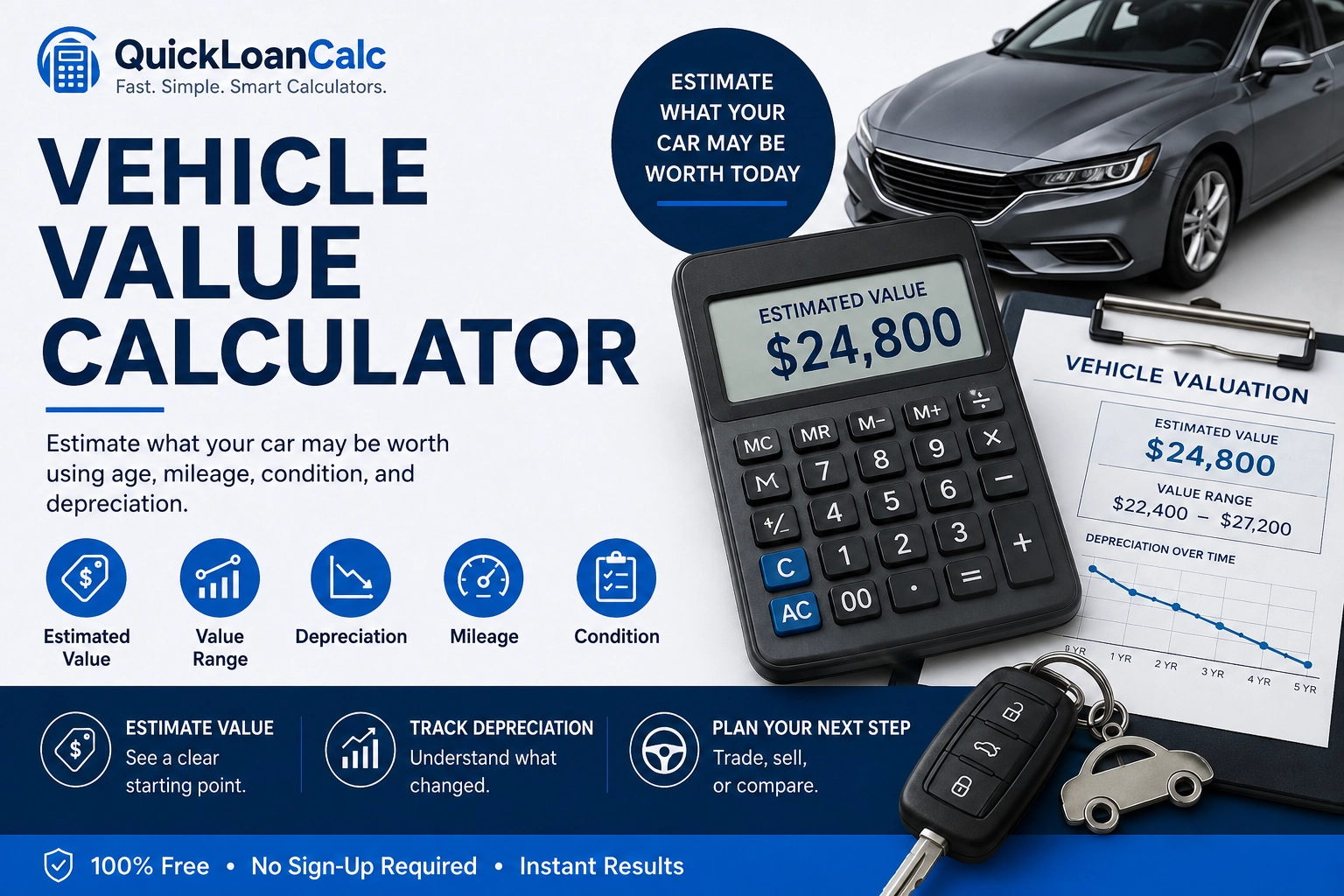
The QuickLoanCalc Vehicle Value Calculator provides a depreciation-based estimate using several of the factors that can influence a vehicle’s remaining value, including its original price, age, mileage, condition, and general market strength.
The calculator is designed to answer a practical question:
“What might my vehicle be worth today?”
Knowing an estimated vehicle value can be useful when you’re:
- Considering a trade-in
- Planning to sell a vehicle
- Comparing leasing and buying
- Calculating vehicle equity
- Deciding whether to repair or replace a car
- Evaluating depreciation
- Reviewing an auto loan balance
- Considering a new purchase
But vehicle valuation is not an exact science.
Two vehicles that originally sold for the same price can have very different values years later.
One may have low mileage, excellent maintenance, clean bodywork, and strong demand.
The other may have high mileage, accident history, mechanical problems, or a trim level with weaker resale demand.
That is why QuickLoanCalc presents the result as an:
Estimated Vehicle Value
rather than claiming to provide an exact appraisal or guaranteed selling price.
Vehicle Value Starts With Depreciation
Most vehicles lose value over time.
That loss in value is called depreciation.
A vehicle generally experiences its fastest depreciation during the first several years of ownership. As the vehicle becomes older, the rate of depreciation may slow, although the actual market value can still vary considerably.
For example, imagine a vehicle originally cost:
Several years later, it may be worth considerably less even if it remains in good mechanical condition.
That decrease matters because it affects:
- Trade-in equity
- Resale proceeds
- Lease economics
- Insurance decisions
- Replacement planning
- Negative equity risk
A vehicle can be functioning perfectly while still losing substantial market value.
Mileage Matters
Mileage is another important part of vehicle valuation.
A five-year-old vehicle with:
30,000 miles
may be viewed differently from an identical five-year-old vehicle with:
120,000 miles
Higher-than-expected mileage generally creates additional wear and may reduce the estimated value.
Lower-than-average mileage can help preserve value, although low mileage alone does not guarantee a premium selling price.
The QuickLoanCalc Vehicle Value Calculator compares your entered mileage against an expected mileage level based on the vehicle’s age.
You can select a typical annual-mileage assumption such as:
10,000 miles
12,000 miles
or:
15,000 miles
Then the calculator evaluates whether your vehicle is above or below that expected range.
Condition Can Make a Meaningful Difference
Mileage tells only part of the story.
Condition also matters.
A vehicle with clean paint, a well-maintained interior, strong mechanical condition, good tires, complete service history, and no major damage may command more than a similar vehicle requiring substantial repairs.
Our calculator allows you to select a broad condition category:
Excellent
Very Good
Good
Fair
Poor
Be realistic when selecting condition.
Most used vehicles will not qualify as truly excellent.
Overestimating condition can produce an unrealistically high result, while underestimating it may make the vehicle appear less valuable than it actually is.
Local Market Conditions Matter Too
Vehicle demand varies.
A certain truck, SUV, hybrid, sports car, or economy vehicle may command a premium in one market while receiving weaker demand somewhere else.
Seasonality can matter.
Fuel prices can matter.
Inventory levels can matter.
Economic conditions can matter.
That’s why the calculator includes an optional broad market adjustment.
This doesn’t replace live market data.
It simply allows you to test how a stronger or weaker local market might influence your estimated result.
Use the Range — Not Just the Middle Number
The calculator provides both:
Estimated Value
and:
Estimated Value Range
The range is important.
A real vehicle may sell for more or less than the midpoint depending on factors that a general depreciation calculator cannot fully measure.
These may include:
- Make
- Model
- Trim
- Engine
- Drivetrain
- Options
- Exterior color
- Accident history
- Title status
- Mechanical condition
- Service history
- Geographic demand
- Current inventory
- Dealer demand
Think of the QuickLoanCalc result as a financial-planning estimate.
It can help you understand whether your vehicle may be worth approximately $15,000, $25,000, or $35,000.
It should not be treated as a guaranteed dealer offer or guaranteed private-party selling price.
Start With What You Know
Enter the vehicle’s:
Original price
Model year
Current mileage
Condition
and:
Typical annual mileage
Then calculate.
You can adjust the inputs to see how age, mileage, condition, and market assumptions change the result.
Understanding depreciation can help you make better decisions about what you already own — and what you plan to buy next.
What is your vehicle worth near you?
Estimate value using the vehicle itself, its mileage, condition, and comparable vehicles in your local market.
Your vehicle
Based on local comparable vehicles.
Similar vehicles near you
No individual comparable listings were available for display, but available market statistics were still used when possible.
Your Vehicle’s Value Is More Than One Number
A vehicle value estimate becomes most useful when you understand what the number represents.
QuickLoanCalc gives you a depreciation-based estimate using the information you entered.
It does not know every detail about your particular vehicle.
It cannot physically inspect the paint.
It cannot listen to the engine.
It cannot see whether the seats are damaged.
It cannot know whether your exact trim is in unusually high demand this week.
And it does not replace a live dealer offer, professional appraisal, auction result, or real-time market database.
That’s why the calculator provides an estimated midpoint and a range.
The range gives you room for the real-world factors that influence vehicle prices.
What Can Make Your Vehicle Worth More?
A vehicle may perform toward the upper end of an estimated range when it has characteristics such as:
- Lower-than-average mileage
- Strong mechanical condition
- Clean interior
- Well-preserved exterior
- Desirable trim
- Popular options
- Good tire condition
- Complete maintenance history
- Clean title history
- Strong local demand
Certain models also retain value significantly better than others.
A vehicle with a reputation for reliability or high resale demand can sometimes outperform a general depreciation estimate.
Special editions, enthusiast vehicles, rare models, and collectible vehicles may behave completely differently from ordinary depreciation patterns.
Those vehicles should not be valued solely with a generic depreciation model.
What Can Reduce Vehicle Value?
The opposite can also occur.
A vehicle may fall below the estimated range because of:
- High mileage
- Accident damage
- Poor maintenance
- Mechanical problems
- Interior damage
- Paint or body damage
- Tire replacement needs
- Warning lights
- Branded title
- Flood history
- Salvage history
- Weak demand
- Undesirable configuration
Even seemingly small issues can influence an actual buyer or dealer offer.
A dealer evaluating a trade-in may also consider the cost of reconditioning the vehicle before resale.
That can reduce the amount offered compared with a private-party selling price.
Trade-In Value and Selling Price Are Not Necessarily the Same
This is an important distinction.
The amount a dealer offers for your trade-in is not necessarily the same amount you might receive selling the vehicle privately.
A dealer must consider costs such as:
- Inspection
- Reconditioning
- Repairs
- Transportation
- Inventory holding costs
- Resale risk
- Profit margin
A private-party buyer may be willing to pay more because the transaction does not include all of those dealer costs.
However, selling privately also requires more effort.
You may need to:
- Advertise the vehicle
- Answer inquiries
- Meet buyers
- Handle paperwork
- Arrange payment
- Deal with negotiations
The highest theoretical vehicle value is not always the easiest value to actually receive.
Vehicle Value Matters When You Still Have a Loan
If the vehicle is financed, compare its estimated value with your current loan payoff.
Suppose your estimated vehicle value is:
$25,000
and your loan payoff is:
$19,000
You may have approximately:
$6,000 in positive equity
before transaction costs or changes in actual market value.
But if the estimated vehicle value is:
$19,000
and you owe:
$25,000
you may have approximately:
$6,000 in negative equity
That difference can become especially important when trading for another vehicle.
Negative equity may have to be paid in cash or potentially rolled into another financing agreement, depending on the lender and transaction.
Rolling old debt into a new loan can increase both the new monthly payment and the amount of interest paid.
This is one reason knowing an approximate vehicle value before visiting a dealership can be useful.
Depreciation Is a Cost of Ownership
People often think about:
Loan payment
Interest
Insurance
Fuel
and:
Maintenance
when calculating vehicle cost.
Depreciation can be just as important.
Imagine buying a $50,000 vehicle and later selling it for $30,000.
Even if you paid cash and never paid a dollar of loan interest, approximately:
$20,000 of value disappeared
during ownership.
That loss in value is part of what the vehicle cost you to own.
Understanding depreciation can therefore help when comparing:
- New vs. used
- Lease vs. buy
- Short-term ownership vs. long-term ownership
- Different vehicle models
- Trade-in timing
Use the Lease vs. Buy Car Calculator if you want to see how estimated vehicle value affects the financial difference between leasing and purchasing.
Use the Auto Loan Interest Calculator if you want to see how much financing adds to the vehicle’s cost.
And use the Car Affordability Calculator if you’re planning your next purchase and want to estimate how much vehicle may fit your budget.
Before Buying a Used Vehicle, Check the VIN
An estimated value tells you what a vehicle might be worth under the assumptions you entered.
Before buying a particular vehicle, you also want to confirm exactly what vehicle you’re evaluating.
The VIN — Vehicle Identification Number — identifies the specific vehicle.
Check the VIN with VinFrenzy.com → https://vinfrenzy.com
VIN information can help you verify important identifying details before you make a purchase decision.
A value estimate and VIN check answer two different questions:
QuickLoanCalc: What might this vehicle be worth?
VinFrenzy: What vehicle am I looking at?
Together, those questions can help you approach a used-car purchase with more information.
Use the Estimate as a Starting Point
No online calculator can guarantee what another person will pay for your vehicle.
The real market ultimately determines the selling price.
But a reasonable estimate gives you a starting point.
If the calculator suggests approximately:
$22,000
and someone offers:
$12,000
you know the difference deserves investigation.
If you’re hoping for:
$35,000
and several market offers cluster around:
$25,000
your original expectation may need adjustment.
Use the estimate.
Compare actual listings.
Review real offers.
Check the vehicle’s condition and VIN.
And then make your decision with a broader understanding of the numbers.
QuickLoanCalc gives you the estimate.
The market gives you the final answer.
Explore QuickLoanCalc’s complete collection of auto financing tools.
Related QuickLoanCalc Tools
Car Loan Calculator → Car Loan Calculator
Compare different loan amounts, rates, and terms.
Car Affordability Calculator → Can I Afford This Car
Estimate how much vehicle may fit your monthly budget.
Down Payment Calculator → Down Payment Calculator
See how putting additional money down affects your financing.
Auto Loan Interest Calculator → Auto Loan Interest Calculator
Compare the interest cost of different rates.
All Car Loan Calculators → Car Loan Calculators
Explore all QuickLoanCalc auto-financing calculators.
Explore QuickLoanCalc’s complete collection of auto financing tools.