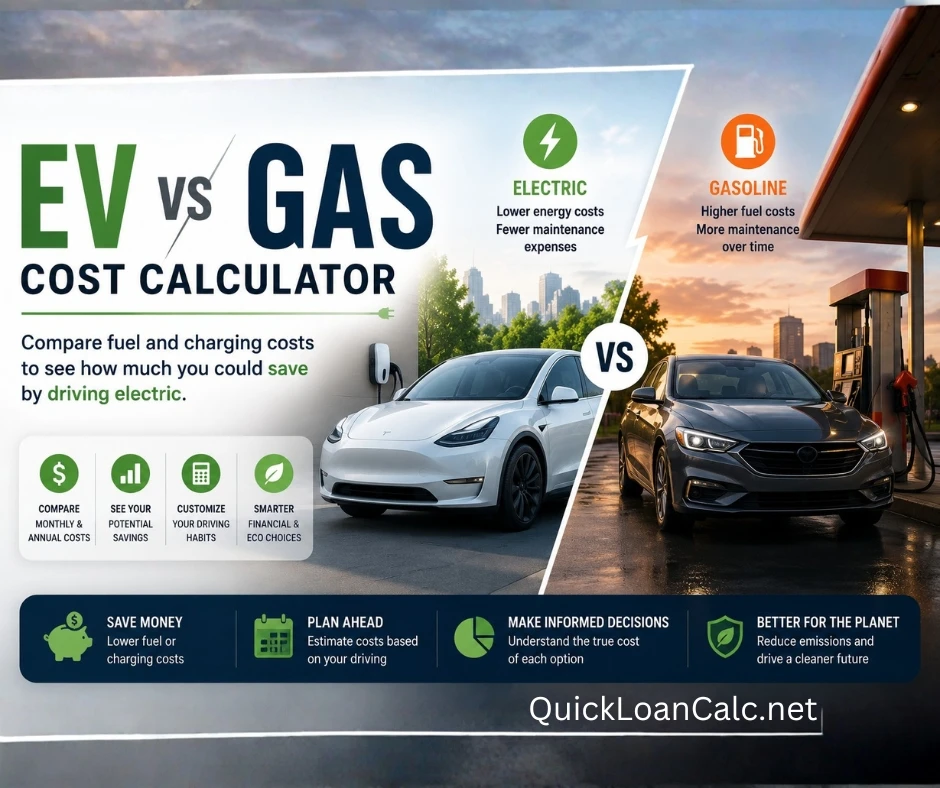
Compare gasoline, home charging, public charging, cost per mile or kilometer, five-year savings, and when an EV may actually break even.
Gasoline has a price.
Electricity has a price.
But comparing a gas vehicle with an electric vehicle isn’t as simple as comparing:
$3.50 per gallon
with:
$0.16 per kWh.
The vehicles use energy differently.
An EV charged mostly at home can have very different operating costs from the same EV using expensive public charging.
A hybrid may close much of the efficiency gap.
And an EV that costs more upfront may take years — or tens of thousands of miles — before lower operating costs recover the difference.
That’s why the QuickLoanCalc Gas vs EV Cost Calculator looks beyond a simple monthly fuel bill.
Compare:
Gasoline or diesel cost
Home EV charging
Public EV charging
Cost per mile or kilometer
Monthly operating cost
Annual operating cost
Five-year cost difference
EV purchase-price premium
Home charger installation
Incentives or rebates
Break-even time
Break-even distance
Break-even fuel price
and:
Break-even electricity rate
Because the real question isn’t simply:
“Is electricity cheaper than gasoline?”
It’s:
“Which vehicle actually costs me less to drive — and when does the answer change?”
Compare Gas vs EV Costs
What Does It Actually Cost You to Drive Gas vs. Electric?
Compare gasoline or diesel fuel with EV charging using miles or kilometers, home and public charging rates, purchase-price differences, charger installation, incentives, and optional ownership costs.
Use one currency for every money field. Currency selection changes formatting only; it does not convert values.
Enter only the EV's additional upfront cost versus the gas vehicle — not the entire EV purchase price.
Optional: Maintenance & Insurance Comparison
Leave these at 0 for a fuel-and-charging-only comparison. Add annual estimates to expand the result beyond energy cost.
The answer depends on the EV premium, charger cost, incentives, annual driving, and operating-cost savings.
Enter your actual driving and energy costs whenever possible.
The calculator supports:
Miles or kilometers
Monthly or annual driving distance
US gallons
Imperial gallons
Liters
MPG
Liters per 100 km
Kilometers per liter
kWh per 100 miles
and:
kWh per 100 kilometers
You can also compare home charging with public charging instead of assuming every kilowatt-hour costs the same.
Start With the Simplest Number: Cost Per Mile
One of the easiest ways to compare gasoline and electricity is to stop thinking in gallons and kilowatt-hours for a moment.
Instead ask:
“What does each vehicle cost me to travel one mile?”
Suppose a gasoline vehicle gets:
28 MPG
and gasoline costs:
$3.50 per gallon.
Estimated fuel cost:
$0.125 per mile.
Now suppose an EV uses:
30 kWh per 100 miles.
If the driver’s blended electricity cost is:
$0.218 per kWh
the EV costs approximately:
$0.065 per mile.
That means:
Gas Vehicle
About:
12.5¢ per mile.
EV
About:
6.5¢ per mile.
Difference:
About 6¢ per mile.
That may not sound enormous.
Until you multiply it by:
15,000 miles per year.
Then:
$0.06 × 15,000 =
$900 per year.
The small number becomes a much bigger one when you apply it to real driving.
Or Compare Cost Per Kilometer
QuickLoanCalc isn’t limited to U.S. measurements.
Suppose you drive in kilometers and your gas vehicle uses:
8.0 L/100 km.
Fuel costs:
€1.70 per liter.
Estimated fuel cost per 100 km:
€13.60.
Now suppose an EV consumes:
18 kWh/100 km.
Electricity costs:
€0.25/kWh.
Estimated EV energy cost:
€4.50 per 100 km.
That’s why this calculator supports both:
Miles
and:
Kilometers.
You shouldn’t have to convert your driving habits into American measurements just to compare vehicles.
Miles, Kilometers, Gallons and Liters All Work
The updated Gas vs EV Cost Calculator supports several measurement systems.
For gasoline or hybrid vehicles, you can use:
MPG using US gallons
MPG using Imperial gallons
Liters per 100 kilometers
or:
Kilometers per liter
Fuel prices can be entered as:
Price per US gallon
Price per Imperial gallon
or:
Price per liter
EV efficiency can be entered as:
kWh per 100 miles
or:
kWh per 100 kilometers
The calculator handles the conversion behind the scenes.
That matters because:
A US gallon and an Imperial gallon are not the same size.
So simply changing the currency or changing miles to kilometers would not be enough.
The underlying units have to change too.
Home Charging and Public Charging Can Be Very Different
This is one of the biggest variables in EV ownership.
Suppose your home electricity costs:
$0.16/kWh.
But public charging costs:
$0.45/kWh.
Those aren’t remotely the same operating cost.
Now suppose you charge:
80% at home
and:
20% publicly.
QuickLoanCalc creates a blended charging rate based on those percentages.
Using the example above:
80% × $0.16
plus:
20% × $0.45
produces an estimated blended electricity cost of:
$0.218/kWh.
Someone charging nearly 100% at home could therefore have very different EV economics from someone who relies heavily on:
Public fast charging.
Example: 1,200 Miles Per Month
Suppose you drive:
1,200 miles each month.
Gas vehicle efficiency:
28 MPG.
Gas price:
$3.50 per gallon.
Estimated gasoline usage:
About:
42.9 gallons per month.
Estimated fuel cost:
About $150 per month.
Annual gas cost:
About $1,800.
Now compare an EV consuming:
30 kWh per 100 miles.
Monthly electricity required:
Approximately:
360 kWh.
Using a blended charging rate of:
$0.218/kWh,
estimated charging cost is approximately:
$78 per month.
Annual charging cost:
About $942.
Estimated annual energy difference:
About $858 in favor of the EV.
But we still haven’t answered the most important question.
Because:
What if the EV costs more to buy?
Cheap to Operate Does Not Automatically Mean Cheaper Overall
Suppose the EV costs:
$5,000 more
than the comparable gasoline vehicle.
Then you spend another:
$1,500
installing home charging equipment.
Extra upfront investment:
$6,500.
If the EV saves approximately:
$858 per year
in energy:
$6,500 ÷ $858 ≈
7.6 years.
That’s the basic operating-cost break-even.
At:
1,200 miles per month,
that represents roughly:
109,000 miles.
So saying:
“The EV is cheaper to fuel”
and saying:
“The EV is cheaper overall”
are not necessarily the same statement.
That’s Why Break-Even Matters
The upgraded QuickLoanCalc calculator doesn’t stop at:
Monthly savings.
It asks:
When does the cheaper operating cost recover the higher upfront cost?
Suppose:
EV A
Costs:
$3,000 more upfront
and saves:
$1,200 per year.
Estimated break-even:
2.5 years.
Now suppose:
EV B
Costs:
$12,000 more upfront
while producing the same:
$1,200 annual savings.
Estimated break-even:
10 years.
Same operating savings.
Very different vehicle decision.
Break-Even Can Be Measured in Distance Too
Time isn’t the only useful measurement.
Suppose an EV breaks even after:
4.2 years.
That result means something different to someone driving:
6,000 miles per year
than to someone driving:
25,000 miles per year.
That’s why QuickLoanCalc also calculates:
Break-Even Miles
or:
Break-Even Kilometers.
If the crossover occurs after:
70,000 miles,
you can compare that with:
- How long you normally keep vehicles
- Your expected annual mileage
- Whether you lease or buy
- Your expected vehicle ownership period
That’s far more useful than an abstract:
“EVs save money eventually.”
Sometimes There Is No Break-Even
The calculator should follow the numbers.
Not a narrative.
Suppose the gasoline vehicle:
- Costs less upfront
- Costs less to fuel
- Costs less to insure
- Costs less to maintain under your entered assumptions
Then:
Gas stays ahead.
There may be no financial crossover.
Likewise, suppose the EV:
- Costs the same or less upfront after incentives
- Costs less to operate
Then:
The EV starts ahead.
There’s nothing to “break even” from.
That’s why QuickLoanCalc doesn’t assume:
EV wins
or:
Gas wins.
You enter the numbers.
The math decides.
What Gas Price Would Make the Costs Equal?
This is one of the most useful results in the calculator.
Go back to our example.
Gas vehicle:
28 MPG.
Current gas price:
$3.50/gallon.
EV:
30 kWh/100 miles.
Blended electricity cost:
$0.218/kWh.
EV energy cost:
Approximately:
6.5¢ per mile.
How cheap would gasoline have to become before the gas vehicle’s fuel cost dropped to approximately the same level?
Around:
$1.83 per gallon.
Now the result becomes much easier to interpret.
Instead of simply knowing:
“EV is cheaper today,”
you know:
How far gasoline prices would have to fall before the answer flips.
What Electricity Price Would Make Gas Cheaper?
We can reverse the calculation.
At:
$3.50/gallon
and:
28 MPG,
the gasoline vehicle costs approximately:
12.5¢ per mile.
An EV consuming:
30 kWh/100 miles
would need electricity priced around:
$0.42/kWh
before the energy cost per mile became approximately equal.
That tells you how much room exists between:
Your current electricity price
and:
The crossover point.
Public Charging Can Move That Crossover Quickly
Imagine two identical EV owners.
Driver A
Charges:
95% at home.
Driver B
Charges:
40% at home
and:
60% publicly.
If public charging is substantially more expensive than residential electricity, Driver B may have:
A much higher cost per mile.
That’s why “EV charging cost” isn’t really one number.
Your answer can depend heavily on:
Where you plug in.
If you’re deciding whether an EV makes financial sense, estimate your realistic charging habits.
Not your ideal charging habits.
Home Charger Installation Should Count
Suppose the EV itself costs:
$4,000 more.
But your house also needs:
- Charging equipment
- Electrical wiring
- Permit work
- Panel changes
- Installation
Total charger-related expense:
$2,000.
Your actual additional upfront commitment may therefore be:
$6,000.
If you’re calculating break-even:
Include it.
That’s why the calculator has a separate:
Home Charger / Electrical Installation
field.
Incentives Can Change the Math
Suppose:
EV premium:
$8,000.
Home charging installation:
$1,500.
Total difference:
$9,500.
Now suppose you’re eligible for:
$3,000
of incentives or rebates.
Net difference:
$6,500.
That’s a substantially different break-even calculation.
QuickLoanCalc allows you to manually enter:
EV Incentive / Rebate.
We don’t automatically assume an incentive because programs, eligibility rules, amounts, locations, and timing can change.
Use:
The amount you reasonably expect to receive.
Gas vs Hybrid vs EV
The gasoline side of the calculator also works for:
Hybrids.
Suppose you’re comparing:
Gas SUV
24 MPG
Hybrid SUV
42 MPG
EV
30 kWh/100 miles
You can run separate scenarios to see how much the hybrid closes the operating-cost difference.
For many buyers, the actual decision isn’t:
Gas or EV.
It may be:
Gas vs Hybrid vs EV.
And depending on purchase price and driving habits:
The hybrid may win.
That’s exactly why the calculator shouldn’t assume the result before you enter the numbers.
Five-Year Cost Can Tell a Different Story
Monthly energy cost is useful.
But vehicle decisions usually last longer than one month.
Suppose:
Gas costs:
$1,800 per year.
EV charging costs:
$900 per year.
Annual energy savings:
$900.
Over five years:
$4,500.
Now suppose the EV initially cost:
$3,000 more.
Ignoring other ownership differences:
Five-year EV advantage:
Approximately $1,500.
Now suppose the EV cost:
$8,000 more.
Same energy savings.
Five-year result:
Gas remains about $3,500 ahead.
That is why the calculator shows a:
Five-Year Net Advantage.
Add Maintenance if You Want a Broader Comparison
Fuel and charging aren’t the only operating expenses.
The upgraded calculator includes an optional section where you can enter:
Gas Vehicle Annual Maintenance
and:
EV Annual Maintenance.
Suppose you estimate:
Gas maintenance:
$900/year.
EV maintenance:
$500/year.
That’s another:
$400 annual difference.
But don’t guess simply to make one vehicle look better.
If you don’t have reasonable estimates:
Leave the fields at zero.
Then QuickLoanCalc performs a pure energy comparison.
Insurance Can Change the Winner Too
Suppose the EV saves:
$100 per month
in energy.
That’s:
$1,200 per year.
But suppose EV insurance costs:
$700 more per year.
Now part of the energy advantage disappears.
That’s why the calculator also allows optional:
Gas Insurance
and:
EV Insurance
figures.
Again:
If you don’t know:
Leave them blank or at zero.
For a purchase decision, getting actual insurance quotes for both vehicles can make the comparison much stronger.
Don’t Double-Count Charging Losses
The calculator includes an optional:
Charging Loss Adjustment.
Use it carefully.
If the efficiency number you’re entering already represents electricity consumed from the wall, don’t add the same losses again.
In that case:
Leave Charging Loss Adjustment at 0%.
If you’re using an efficiency number that excludes charging losses, you can optionally add an adjustment.
The purpose of the field is:
Better modeling.
Not automatically making the EV look less efficient.
Temperature Can Change Real-World Results
A vehicle’s published efficiency is not a guarantee that every driver will get the same result.
Gasoline and EV efficiency can change with:
- Temperature
- Highway speed
- Traffic
- Acceleration
- Elevation
- Wind
- Tires
- Towing
- Payload
- Cabin heating
- Air conditioning
- Driving style
An EV driven through a mild climate may produce very different real-world energy consumption from one regularly operated in extremely cold conditions.
Likewise, an aggressively driven gasoline vehicle may achieve substantially worse fuel economy than its rating.
If you know your real-world efficiency:
Use it.
Run Your Real Numbers — Then Stress-Test Them
Don’t run only one scenario.
Try:
Scenario 1 — Today’s Prices
Use current gasoline and electricity rates.
Then:
Scenario 2 — Cheaper Gas
Reduce fuel price.
Does the winner change?
Then:
Scenario 3 — More Expensive Electricity
Increase home or public charging cost.
Does the winner change?
Then:
Scenario 4 — More Public Charging
Change your charging mix.
Then:
Scenario 5 — More Driving
Increase annual mileage.
Higher-mileage drivers may reach break-even much faster when one vehicle has a substantially lower operating cost per mile.
The goal is not to find the scenario that proves your preferred vehicle is cheaper.
The goal is:
Find out how strong the result really is.
More Miles Can Change the Decision Dramatically
Suppose an EV saves:
6¢ per mile.
At:
5,000 miles per year
that’s:
$300 annual savings.
At:
15,000 miles
that’s:
$900.
At:
30,000 miles
that’s:
$1,800.
Same vehicles.
Same energy prices.
Different driver.
That’s why asking:
“Are EVs cheaper?”
without knowing mileage can be almost meaningless.
The real question is:
“Is this EV cheaper for how I drive?”
Low-Mileage Drivers May See a Very Different Result
Suppose you drive:
4,000 miles per year.
Even if the EV saves:
$0.08 per mile,
annual savings are only:
$320.
If the EV costs:
$8,000 more upfront,
energy savings alone could take:
Decades
to recover that difference.
That doesn’t mean you shouldn’t buy the EV.
You may prefer:
- Performance
- Quiet operation
- Technology
- Convenience
- Driving experience
- Environmental considerations
But financially:
Low annual mileage can make operating-cost savings much less important.
High-Mileage Drivers May Have the Opposite Experience
Now suppose you drive:
30,000 miles every year.
Even a:
5¢ per-mile
advantage becomes:
$1,500 annually.
An:
8¢ advantage
becomes:
$2,400.
For high-mileage drivers:
Energy efficiency can become a major ownership-cost variable.
That’s why mileage belongs at the top of this calculator.
Fuel Cost Is Not Total Vehicle Cost
This calculator can compare:
- Fuel
- Charging
- Maintenance
- Insurance
- Upfront EV premium
- Charger installation
- Incentives
But it deliberately does not try to calculate every aspect of vehicle ownership.
You may also need to consider:
- Vehicle price
- Financing
- Interest
- Down payment
- Taxes
- Registration
- Depreciation
- Tires
- Repairs
- Resale value
That’s where QuickLoanCalc’s other tools come in.
Can You Afford the Vehicle — Not Just the Fuel?
Suppose the EV saves:
$100 per month
in energy.
Great.
But suppose its loan payment is:
$350 per month higher.
Your household cash flow may still be:
$250 per month higher.
Energy affordability and vehicle affordability are:
Two different questions.
Use it to look beyond fuel and see how the vehicle may fit into your broader monthly budget.
Calculate the Financing Difference
Suppose the EV costs:
$8,000 more.
If you’re financing the purchase:
You’re potentially financing that difference too.
And financed money may create:
Interest.
Use:
to compare payments.
Then:
➡️ Auto Loan Interest Calculator
to see what financing the difference may cost over the full term.
Compare Your Down Payment
An EV and gasoline vehicle may require different amounts of cash upfront.
Use:
to compare how different down payments change the amount remaining to finance.
Remember:
Lower operating cost doesn’t erase the cash you spend upfront.
Vehicle Value Matters Too
Suppose an EV saves:
$5,000
in energy over several years.
But the two vehicles have very different resale values.
That could change the overall ownership picture.
QuickLoanCalc keeps depreciation separate because it depends heavily on:
- Vehicle
- Age
- Mileage
- Condition
- Market
- Ownership period
Use:
to estimate another piece of the ownership equation.
Leasing Can Change the Break-Even Question
Suppose the Gas vs EV Calculator estimates:
EV break-even in 6.5 years.
But you’re considering:
A 3-year lease.
That creates a very different question.
You may never own the vehicle long enough to reach the calculated purchase-cost break-even.
Compare:
➡️ Lease vs. Buy Car Calculator
before treating a long-term break-even result as automatically relevant to a short-term lease.
The Dealership Numbers Matter Too
The EV may qualify for:
- Dealer incentives
- Manufacturer discounts
- Rebates
- Special financing
The gasoline vehicle may have completely different transaction terms.
So before comparing only sticker prices:
Compare the actual deal.
can help reconstruct the transaction and see how the dealer’s financing numbers fit together.
What Does the Vehicle Cost in Working Time?
Suppose one vehicle costs:
$2,400 more per year
to operate.
And you take home:
$30 per hour.
$2,400 ÷ $30 =
80 hours of work.
That’s approximately:
Two full 40-hour workweeks.
Now the difference isn’t simply:
$2,400.
It’s:
Two weeks of working time.
can help translate vehicle financing into estimated work hours, workdays, and workweeks.
Frequently Asked Questions
Is an EV cheaper to drive than a gas car?
It can be, but the result depends on vehicle efficiency, gasoline price, electricity price, public charging use, driving distance, and other operating expenses.
Use your actual numbers whenever possible.
How much does it cost to charge an EV?
EV charging cost depends on:
Energy consumed × electricity price.
For example:
30 kWh per 100 miles at $0.20/kWh equals:
$6 per 100 miles.
Is home charging cheaper than public charging?
It can be.
Public charging and home electricity may have substantially different rates.
That’s why QuickLoanCalc allows separate:
Home Charging Rate
and:
Public Charging Rate
inputs.
Can I use kilometers instead of miles?
Yes.
Select:
Kilometers
and the calculator will display distance and relevant results in kilometers.
Can I enter fuel price per liter?
Yes.
Fuel prices can be entered per:
- US gallon
- Imperial gallon
- Liter
Can I use L/100 km?
Yes.
The gasoline side supports:
Liters per 100 km
as well as:
km/L
and MPG.
Does it support Imperial MPG?
Yes.
US and Imperial gallons are treated separately.
Can I compare a hybrid with an EV?
Yes.
Enter the hybrid’s gasoline fuel economy and compare it with the EV.
What is EV break-even?
Break-even estimates when cumulative operating-cost savings recover the additional EV upfront cost entered into the calculator.
What is break-even distance?
Break-even distance estimates how many miles or kilometers must be driven before the operating-cost difference recovers the entered upfront difference.
What is break-even fuel price?
It estimates the fuel price at which the gasoline vehicle and EV would have approximately the same energy cost per unit of distance under the assumptions entered.
What is break-even electricity rate?
It estimates the blended electricity rate at which the EV and gasoline vehicle would have approximately equal energy cost per distance.
Does the calculator include a home charger?
Yes.
Enter your expected home charging-equipment or electrical-installation cost.
Can I enter an EV rebate or incentive?
Yes.
Enter an incentive manually if you reasonably expect to receive it.
The calculator does not automatically determine eligibility.
Does it include insurance?
Optionally.
Enter annual gas and EV insurance estimates if you want them included in the operating-cost comparison.
Does it include maintenance?
Optionally.
Enter annual maintenance estimates for both vehicles.
Does it include depreciation?
No.
Use:
for a separate vehicle-value estimate.
Does it include loan payments and interest?
No.
Use:
and:
➡️ Auto Loan Interest Calculator
for financing.
Gas vs EV Isn’t a Debate Here
QuickLoanCalc doesn’t need:
Gas to win.
And it doesn’t need:
EV to win.
We need:
The numbers to win.
For one driver, the EV could save thousands.
For another, the gas vehicle could remain cheaper for the entire ownership period.
For someone else:
A hybrid may make the most sense.
It depends on:
How much you drive
What fuel costs
What electricity costs
Where you charge
Vehicle efficiency
Upfront price
and:
How long you keep the vehicle.
That’s exactly what the calculator is designed to expose.
Don’t Ask “Which Is Cheaper?”
Ask:
“Which Is Cheaper for Me?”
Your driving.
Your fuel price.
Your electricity rate.
Your charging habits.
Your vehicle choices.
Your purchase-price difference.
Your ownership period.
Those are the numbers that matter.
Run the calculation.
Change the assumptions.
See where the answer flips.
Then make the decision with:
The real numbers in front of you.
Continue the Vehicle Comparison
➡️ Can I Afford This Car?
See whether the vehicle payment and broader ownership expenses may fit your monthly budget.
➡️ Car Loan Calculator
Calculate estimated monthly payments based on loan amount, APR, and term.
➡️ Auto Loan Interest Calculator
See how much financing may add to the vehicle’s total cost.
➡️ Down Payment Calculator
Compare different upfront cash amounts and the amount remaining to finance.
➡️ Vehicle Value Calculator
Estimate vehicle value using age, mileage, condition, and depreciation.
➡️ Lease vs. Buy Car Calculator
Compare leasing against buying over the same period.
➡️ Dealer Deal Decoder
Reconstruct the dealership transaction and see whether the financing figures reconcile.
➡️ Loan Life Cost Calculator
Convert loan repayment and interest into estimated work hours, workdays, and workweeks.
➡️ All Car Loan Calculators
Explore the full QuickLoanCalc vehicle-financing collection.
Before You Buy, Check the VIN
A VIN can help verify important identifying information about the vehicle before you complete a purchase or financing agreement.
➡️ Check the vehicle VIN with VinFrenzy.com
Financing tells you what the money may cost.
Checking the VIN helps you learn more about the vehicle you’re financing.
Important Information
QuickLoanCalc.net provides calculators and educational information for general informational purposes.
Gas and EV calculations are estimates based on the values entered by the user.
Actual vehicle costs may vary because of:
- Real-world fuel economy
- EV efficiency
- Fuel prices
- Residential electricity rates
- Time-of-use electricity pricing
- Public charging rates and fees
- Weather
- Temperature
- Driving style
- Highway speed
- Traffic
- Towing
- Vehicle payload
- Climate-control use
- Charging losses
- Maintenance
- Insurance
- Vehicle condition
Break-even calculations are mathematical estimates and do not guarantee that one vehicle will become financially cheaper at a particular date or mileage.
Five-year calculations do not automatically include full vehicle purchase price, financing interest, taxes, registration, depreciation, resale value, battery replacement, repairs, or other ownership costs unless those costs are specifically represented by calculator inputs.
Incentives, rebates, tax credits, utility programs, and manufacturer offers may change and may have eligibility requirements.
Currency selection changes how monetary figures are displayed. It does not convert values between currencies. Enter all monetary figures using the same selected currency.
Measurement conversions are provided for comparison purposes and may differ slightly because of rounding.
QuickLoanCalc.net is not a vehicle dealer, lender, manufacturer, utility provider, charging network, financial advisor, accountant, or tax advisor.
Always verify current vehicle specifications, energy prices, financing terms, incentives, insurance costs, and other relevant information before making a purchase decision.
Last reviewed: September 2026