
Estimate your down payment instantly for homes, cars, RVs, boats, and more.
The purchase price is only the beginning.
Before financing a car, home, RV, boat, motorcycle, or other major purchase, one number immediately changes the rest of the deal:
Your down payment.
Put more money down and you generally borrow less.
Put less money down and you keep more cash today—but may need to finance more of the purchase.
The QuickLoanCalc Down Payment Calculator helps you instantly compare:
Purchase Price
Down Payment Amount
Down Payment Percentage
and:
Amount Financed
Use it to test different scenarios before deciding how much cash you want to commit upfront.
A Down Payment Is More Than Money Up Front
Your down payment affects the starting size of the loan.
Suppose something costs:
$50,000
With:
5% Down
Down payment:
$2,500
Amount remaining:
$47,500
10% Down
Down payment:
$5,000
Amount remaining:
$45,000
20% Down
Down payment:
$10,000
Amount remaining:
$40,000
Nothing about the purchase itself changed.
But the amount that may need to be financed changed by:
$7,500
between the 5% and 20% examples.
That difference can affect the payment and financing cost once a loan is applied.
Calculate Your Down Payment
Down Payment Calculator
Estimate your down payment and remaining loan amount instantly.
Results are estimates and may vary based on lender terms.
Enter the:
- Purchase price
- Down payment amount
or:
- Down payment percentage
The calculator will show:
Down Payment
Down Payment Percentage
Amount Remaining to Finance
Then take the resulting loan amount into the appropriate QuickLoanCalc financing calculator to see what the loan itself could cost.
Don’t Ask Only “How Much Should I Put Down?”
There is no single down-payment percentage that is right for every person or every purchase.
A more useful question is:
“What changes if I put this much down?”
You may be balancing several things at once:
- Lower amount financed
- Lower potential monthly payment
- Lower potential interest cost
- Cash remaining in savings
- Emergency reserves
- Closing costs
- Taxes and fees
- Trade-in equity
- Other financial priorities
The biggest down payment isn’t automatically the best financial decision.
And the smallest down payment isn’t automatically the best either.
The purpose of this calculator is to let you compare the trade.
Down Payment vs. Amount Financed
The basic relationship is simple:
Purchase Price − Down Payment = Remaining Purchase Amount
For example:
Purchase price:
$40,000
Down payment:
$8,000
Remaining amount:
$32,000
That remaining amount is a useful starting point for estimating financing.
However, the actual Amount Financed on a contract can be different because a real transaction may also include:
- Sales tax
- Dealer fees
- Closing costs
- Registration
- Government fees
- Optional products
- Negative equity
- Credits
- Rebates
- Trade equity
- Other transaction costs
So think of the Down Payment Calculator as:
Step One.
Then calculate the actual financing structure.
How Much Is 5%, 10%, 15% or 20% Down?
Here’s a quick comparison:
| Purchase Price | 5% Down | 10% Down | 15% Down | 20% Down |
|---|---|---|---|---|
| $20,000 | $1,000 | $2,000 | $3,000 | $4,000 |
| $30,000 | $1,500 | $3,000 | $4,500 | $6,000 |
| $50,000 | $2,500 | $5,000 | $7,500 | $10,000 |
| $75,000 | $3,750 | $7,500 | $11,250 | $15,000 |
| $100,000 | $5,000 | $10,000 | $15,000 | $20,000 |
| $250,000 | $12,500 | $25,000 | $37,500 | $50,000 |
| $400,000 | $20,000 | $40,000 | $60,000 | $80,000 |
| $500,000 | $25,000 | $50,000 | $75,000 | $100,000 |
The percentages stay the same.
But as the purchase gets larger, relatively small percentage changes become:
Very large dollar amounts.
Example: Down Payment on a $30,000 Car
Suppose the vehicle costs:
$30,000
$3,000 Down
That’s:
10%
leaving:
$27,000
before considering taxes, fees, trade value, or other transaction items.
$6,000 Down
That’s:
20%
leaving:
$24,000
The difference between those two scenarios is:
$3,000 less potentially financed.
Now take those amounts to:
and compare what happens when interest and loan term are added.
Example: Down Payment on a $50,000 Car
Purchase price:
$50,000
5% Down
$2,500
Remaining purchase amount:
$47,500
10% Down
$5,000
Remaining purchase amount:
$45,000
20% Down
$10,000
Remaining purchase amount:
$40,000
That $10,000 down payment reduces the purchase amount remaining by twice as much as the 10% example.
But another question matters:
What happens to your cash after you put $10,000 down?
If that leaves you with strong reserves, that’s one situation.
If that empties most of your savings, that’s another.
A Down Payment Can Lower the Loan Without Making the Purchase Cheaper
This distinction matters.
Suppose a vehicle costs:
$60,000.
You put:
$15,000 down.
You may only need to finance approximately:
$45,000
before other transaction costs.
But the vehicle did not suddenly become a $45,000 vehicle.
You paid:
$15,000 today
and may finance:
$45,000 afterward.
The down payment changes:
When you pay the money.
It does not erase the purchase cost.
Don’t Let a Large Down Payment Hide an Expensive Purchase
Imagine two offers.
Option A
Vehicle price:
$50,000
Down payment:
$5,000
Option B
Vehicle price:
$70,000
Down payment:
$25,000
Both may leave roughly:
$45,000
before other costs.
So both could potentially create similar financed balances.
But you’ve committed dramatically more upfront cash to Option B.
When comparing purchases, look at:
Purchase price
Cash down
and:
Amount financed
separately.
Should I Put More Money Down on a Car?
A larger vehicle down payment can reduce the amount that must be financed.
That can potentially mean:
- Lower monthly payment
- Less interest
- Lower loan balance
- Less chance of starting deeply upside down
But there are trade-offs.
That same cash could otherwise remain available for:
- Emergency savings
- Insurance
- Repairs
- Home expenses
- Investments
- Other debt
- Business needs
So instead of asking:
“What’s the biggest down payment I can make?”
consider asking:
“What down payment gives me the financing I want without leaving me cash-poor?”
See What the Car Payment Looks Like Next
Once you calculate the remaining amount, don’t stop.
Suppose your Down Payment Calculator says:
$42,000 remaining.
Now you need to know:
- What does $42,000 cost at 6%?
- What about 9%?
- 60 months?
- 72 months?
- 84 months?
Then:
➡️ Auto Loan Interest Calculator
to see how much of the final cost may come from interest.
Can You Actually Afford the Car After the Down Payment?
A down payment can make an expensive car’s payment look more manageable.
But affordability still includes:
- Insurance
- Fuel
- Maintenance
- Tires
- Repairs
- Registration
- Other debt
- Housing expenses
So after testing the down payment:
Look at whether the vehicle fits the bigger budget rather than only whether the remaining loan fits.
Down Payment and Trade-In Are Not the Same Thing
When buying a car, you may reduce the amount financed using:
Cash down
and:
Trade equity.
Suppose:
Vehicle price:
$50,000
Cash down:
$5,000
Trade value:
$15,000
Trade payoff:
$10,000
Your trade may have approximately:
$5,000 of positive equity.
Combined with $5,000 cash down, that could reduce the transaction by roughly:
$10,000
before considering taxes, fees, and other transaction items.
But if the trade payoff is higher than its value, the opposite can happen.
Negative Equity Can Cancel Out Your Down Payment
Suppose:
Cash down:
$5,000
But your trade has:
$5,000 in negative equity.
Those two amounts can effectively work against one another in the overall transaction.
You handed over $5,000.
But you’re also bringing approximately $5,000 of old debt into the new deal.
That’s why a dealership transaction needs more than a simple down-payment calculation.
Use it to reconstruct:
- Selling price
- Cash down
- Trade value
- Trade payoff
- Taxes
- Dealer fees
- Add-ons
- Amount Financed
- Quoted payment
and see where the money actually went.
A Bigger Down Payment May Reduce Negative-Equity Risk
Vehicles typically lose value over time.
If you finance nearly the entire transaction—including taxes, fees, products, or old negative equity—you may begin with a loan balance considerably higher than the vehicle’s value.
A larger down payment can reduce the starting loan balance.
That can potentially reduce the gap between:
What you owe
and:
What the vehicle may be worth.
Use it to estimate how depreciation, mileage, age, and condition may affect vehicle value over time.
Now Look at a Home Down Payment
A home down payment works from the same basic concept:
Home Price − Down Payment = Starting Loan Amount
Suppose a home costs:
$400,000.
3% Down
Down payment:
$12,000
Starting balance before other financing considerations:
$388,000
5% Down
Down payment:
$20,000
Starting balance:
$380,000
10% Down
Down payment:
$40,000
Starting balance:
$360,000
20% Down
Down payment:
$80,000
Starting balance:
$320,000
The difference between 3% and 20% down is:
$68,000.
That difference can substantially change the mortgage balance.
But there is much more to buying a home than the down payment.
Your Home Down Payment Is Not Your Cash Needed to Close
This may be one of the most important distinctions on this page.
Suppose you saved:
$40,000
for a house.
That doesn’t necessarily mean you can use the entire $40,000 as the down payment.
A home purchase may also require money for:
- Lender fees
- Title or escrow charges
- Appraisal
- Inspection
- Recording fees
- Prepaid property taxes
- Homeowners insurance
- Escrow deposits
- Other closing expenses
Your:
Down Payment
and:
Cash Needed to Close
are not necessarily the same number.
Use it before deciding how much of your available cash should become the down payment.
Example: $400,000 Home With $40,000 Down
Home price:
$400,000
Cash down:
$40,000
Down payment percentage:
10%
Approximate starting mortgage amount:
$360,000
But now the real questions begin.
What will that mortgage payment be?
What will property taxes add?
Insurance?
HOA?
Mortgage insurance if applicable?
The Down Payment Calculator tells you:
How much remains.
The Mortgage Calculator tells you:
What financing that amount may actually look like.
You May Not Need 20% Down to Buy a Home
Twenty percent is a familiar benchmark, but it isn’t a universal requirement for every mortgage.
Different mortgage programs and lenders may allow different minimum down payments, depending on factors such as:
- Loan program
- Property
- Borrower eligibility
- Credit
- Occupancy
- Lender requirements
So don’t assume:
“I can’t buy until I have 20%.”
And don’t assume:
“The minimum down payment is automatically best.”
Compare the complete loan.
The goal isn’t simply to qualify.
It’s to understand:
What the financing does to your monthly and long-term cost.
Less Down Can Preserve Cash
Suppose you’re buying a:
$400,000 home.
You could put:
$80,000 down
or perhaps choose a financing option requiring substantially less upfront.
Keeping more cash may leave room for:
- Repairs
- Furniture
- Moving expenses
- Emergency savings
- Renovations
- Reserves
But a smaller down payment may also mean:
- Larger mortgage balance
- Larger monthly principal-and-interest payment
- More total interest
- Possible mortgage-insurance considerations depending on the loan
Neither option is automatically right.
That’s why you compare scenarios.
More Down Can Change Home Affordability
A larger down payment may allow you to:
- Borrow less
- Reduce the mortgage payment
- Change the loan-to-value relationship
- Potentially improve affordability
If you’re trying to determine how much house might fit your finances:
➡️ Home Affordability Calculator
It looks beyond the down payment and considers income, debt, taxes, insurance, HOA expenses, and estimated mortgage costs.
Down Payment vs. Closing Costs
Consider:
Home price:
$500,000
Available cash:
$75,000
It might be tempting to say:
“I’ll put all $75,000 down.”
But what about:
- Closing costs
- Prepaid insurance
- Taxes
- Escrow deposits
- Moving
- Repairs
- Emergency reserves?
The better question may be:
“How should I divide my available cash?”
That’s a very different problem.
Calculate the down payment here.
Then:
to estimate the rest of the upfront transaction.
An RV, Boat or Motorcycle Down Payment Works the Same Way
The calculator isn’t limited to homes and cars.
You can use it for:
- RVs
- Boats
- Motorcycles
- ATVs
- Trailers
- Equipment
- Other financed purchases
For example:
Boat price:
$80,000
15% down:
$12,000
Remaining purchase amount:
$68,000
Or:
RV price:
$120,000
20% down:
$24,000
Remaining purchase amount:
$96,000
Then use:
➡️ Free Loan Payment Calculator
to estimate the payment and interest based on the financing terms you’re considering.
Your Down Payment Has a Time Cost Too
There’s another way to look at cash down.
Suppose you’re considering:
$15,000 down.
If your take-home earnings average:
$30 per hour,
that $15,000 represents approximately:
500 hours of work.
You’ve already earned that money.
Now ask whether using it today saves enough future financing cost to make the trade worthwhile for you.
can help translate the resulting loan repayment into estimated work hours, workdays, and workweeks.
That gives you two perspectives:
Cash already earned
and:
Future work required.
A Down Payment Is Really a Choice Between Cash Today and Debt Tomorrow
Strip everything else away and that’s the trade.
More Down
More cash leaves today.
Less may need to be borrowed tomorrow.
Less Down
More cash stays with you today.
More may need to be financed tomorrow.
There isn’t one universal answer.
The calculator lets you move the number up and down until you find the balance that makes sense for:
Your purchase.
Your savings.
Your loan.
Your life.
Run Three Down-Payment Scenarios
Instead of testing only one number, try three.
For example:
Conservative Cash Scenario
Put less down and preserve more savings.
Balanced Scenario
Use a moderate down payment.
Lower-Loan Scenario
Put more down and reduce the remaining amount substantially.
Then compare each scenario using the appropriate loan calculator.
That is more informative than assuming one percentage is automatically correct.
Frequently Asked Questions
What is a down payment?
A down payment is money paid upfront toward the purchase price.
The remaining purchase amount may then be financed, subject to taxes, fees, credits, trade-ins, lender terms, and other transaction details.
How do I calculate a down payment percentage?
Use:
Down Payment ÷ Purchase Price × 100
For example:
$5,000 ÷ $50,000 × 100 =
10%
How do I calculate a down payment amount from a percentage?
Use:
Purchase Price × Down Payment Percentage
For example:
$40,000 × 20% =
$8,000
How much is 10% down on $30,000?
$3,000
leaving approximately:
$27,000
of the purchase price remaining.
How much is 20% down on $50,000?
$10,000
leaving:
$40,000
before considering other transaction costs.
How much is 5% down on a $400,000 house?
$20,000
leaving approximately:
$380,000
before considering other mortgage and transaction details.
How much is 10% down on a $400,000 house?
$40,000
leaving approximately:
$360,000.
Do I need 20% down to buy a house?
Not necessarily.
Mortgage down-payment requirements vary by loan program, lender, property, and borrower eligibility.
A 20% down payment is one scenario—not a universal requirement.
Is a larger down payment always better?
No.
A larger down payment reduces the amount remaining to finance, but it also uses more cash upfront.
Consider emergency savings, closing expenses, other debts, and financial priorities.
Does a down payment lower my car payment?
Generally, financing a smaller amount at the same rate and term produces a lower payment.
Use the:
to compare the actual payment after entering the resulting loan amount.
Does a larger down payment save interest?
Generally, borrowing less principal under otherwise identical loan terms results in less interest being charged.
Use:
➡️ Auto Loan Interest Calculator
or:
➡️ Free Loan Payment Calculator
to compare the financing scenarios.
Does my trade-in count as a down payment?
Positive trade equity may reduce the amount that needs to be financed, although transaction and tax treatment vary.
A trade with negative equity can have the opposite effect.
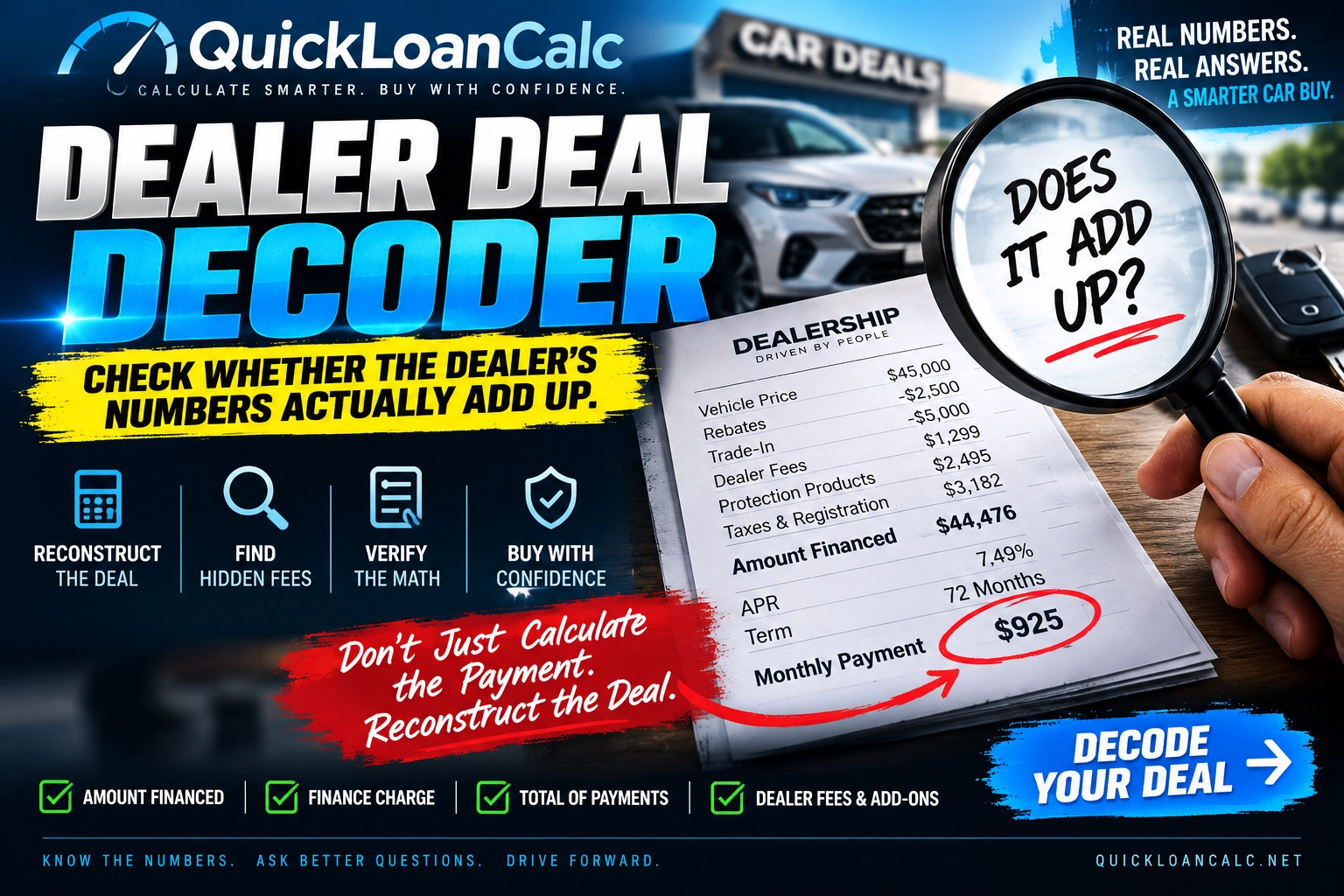
can help reconstruct a vehicle transaction.
Are closing costs included in a home down payment?
No. A down payment and closing costs are separate concepts.
Homebuyers may need additional cash for lender charges, title and escrow costs, prepaid expenses, and other closing items.
Can I use this calculator for an RV or boat?
Yes.
Enter the purchase price and either your desired down-payment amount or percentage to calculate the remaining purchase amount.
Don’t Pick a Down Payment in Isolation
Before deciding how much to put down, ask:
What am I buying?
How much cash will remain afterward?
How much will I need to finance?
What will that loan payment be?
What will the interest cost?
Are there other upfront expenses?
What happens if I need cash next month?
A down payment is only one piece of the financing decision.
QuickLoanCalc lets you take the next step.
Start Here. Then Follow the Money.
If You’re Buying a Car
Calculate your down payment.
Then:
calculate the payment.
➡️ Auto Loan Interest Calculator
calculate financing cost.
check the bigger monthly budget.
reconstruct the dealership transaction.
Before You Buy, Check the VIN
A VIN can help verify important identifying information about the vehicle before you sign a purchase or financing agreement.
➡️ Check the vehicle VIN with VinFrenzy.com
Financing tells you what the money may cost.
Checking the VIN helps you learn more about the vehicle you’re spending that money on.
If You’re Buying a Home
Calculate the down payment.
Then:
estimate additional cash needed.
calculate the monthly housing cost.
➡️ Home Affordability Calculator
see how the purchase may fit your income and debt.
➡️ Mortgage Calculators & Home Financing Tools
explore the complete home-financing calculator collection.
If You’re Financing Something Else
Calculate the down payment.
Then:
➡️ Free Loan Payment Calculator
compare payment, interest, term, and total repayment.
And if you want another perspective:
see how much working time the financing represents.
The Best Down Payment Is the One You Understand
The biggest down payment isn’t automatically best.
The minimum down payment isn’t automatically best.
The number should make sense when you consider:
Cash today
Debt tomorrow
Monthly payment
Interest
Reserves
and:
The rest of your finances.
Start with the purchase price.
Move the down payment up.
Move it down.
Watch the amount remaining change.
Then calculate what happens next.
Don’t guess at the down payment.
Test it.
Important Information
QuickLoanCalc.net provides calculators and educational information for general informational purposes.
The Down Payment Calculator performs a mathematical comparison between purchase price, down-payment amount, down-payment percentage, and remaining purchase amount.
The amount shown as remaining does not necessarily equal the final Amount Financed on a loan or contract.
Actual financing may include taxes, closing costs, dealer fees, registration costs, optional products, trade equity, negative equity, rebates, credits, lender fees, mortgage insurance, funding fees, and other transaction items.
Mortgage, vehicle, RV, boat, and other loan requirements vary by lender, loan program, borrower, property or asset, jurisdiction, and transaction.
QuickLoanCalc.net is not a lender, loan broker, mortgage company, dealer, financial advisor, legal advisor, accountant, or tax advisor.
Always review official lender disclosures and your complete financial circumstances before entering into financing.
Last reviewed: September 2026