Mortgage Reality
Loan Reality

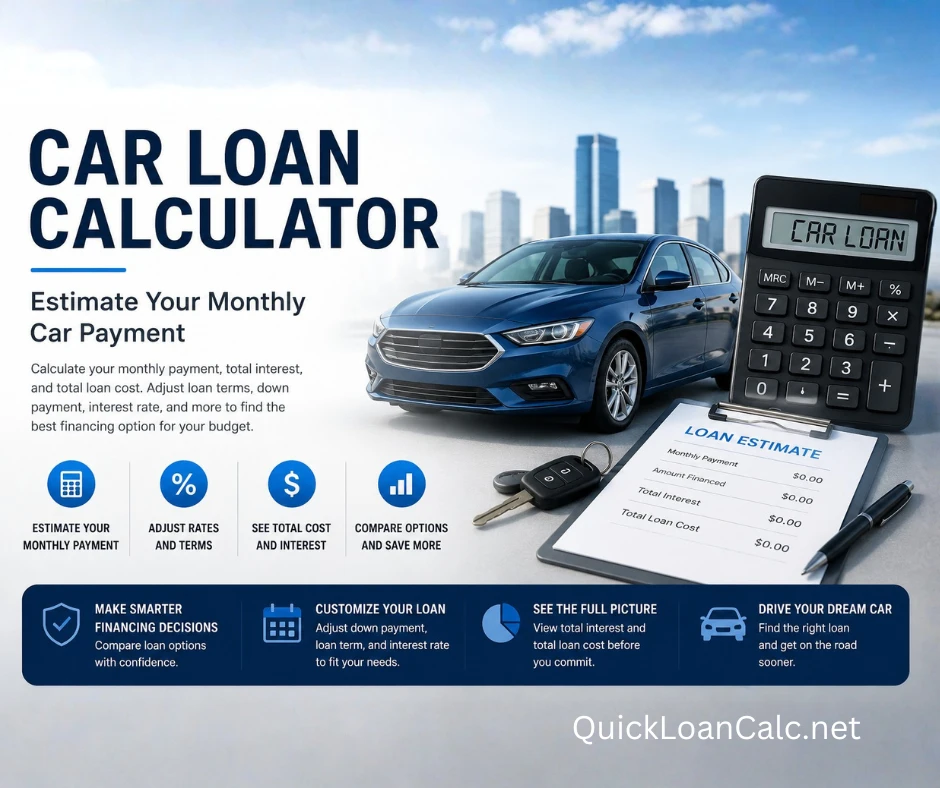
Car Loan Calculator — Estimate Your Payment & Total Loan Cost

Calculate your monthly car payment, amount financed, total interest, and scheduled loan repayment before you buy.

A vehicle may have a price of:

$25,000

$45,000

$75,000

or more.

But the sticker price does not automatically tell you:

What the loan will cost.

Your actual financing can change based on:

Down payment

Trade-in value

Sales tax

Fees

Interest rate

and:

Loan term.

The QuickLoanCalc Car Loan Calculator helps you estimate:

Amount financed

Monthly payment

Total interest

Total loan repayment

and:

How much interest adds to the amount you finance.

Because a car loan should never be judged by:

Monthly payment alone.


Calculate Your Car Loan

QuickLoanCalc.net

Car Loan Calculator

Estimate your monthly payment, amount financed, total interest, and total loan repayment.

Formatting only. Changing currency does not convert entered values.

Amount Financed
Monthly Payment
Total Interest
Total Loan Repayment
Interest Added
Educational estimate only. Tax treatment, taxable fees, trade-in credits, registration charges, lender fees, and other transaction costs vary by jurisdiction and deal structure. Verify actual figures before signing.

Enter:

Vehicle price

Down payment

Trade-in value

Sales tax

Fees

Interest rate

and:

Loan term.

Then calculate.

Change the rate.

Try another term.

Increase the down payment.

Add a trade-in.

The goal is not simply to find:

“A payment I can live with.”

The goal is to understand:

What creates that payment.


Example: Financing a $25,000 Vehicle

Suppose the vehicle price is:

$25,000.

You put:

$3,000 down.

Trade-in:

$0.

Estimated sales tax:

7%.

Fees:

$0.

Interest rate:

6.90%.

Loan term:

60 months.

Under the calculator’s tax assumption, estimated sales tax is:

$1,750.

That creates an estimated amount financed of:

$23,750.

Estimated monthly payment:

$469.16.

Estimated total interest:

$4,399.52.

Estimated total loan repayment:

$28,149.52.

So even though the amount financed is:

$23,750,

the scheduled loan repayment is approximately:

$28,150.

That’s the number a payment-only conversation can hide.


The Vehicle Price Is Not Always the Amount Financed

Suppose the vehicle costs:

$25,000.

That does not necessarily mean you finance:

$25,000.

You may subtract:

Down payment

and:

Trade-in value.

But you may also add:

Sales tax

and:

Fees.

So a simplified financing calculation can look like:

Vehicle Price

− Down Payment
− Trade-In

  • Estimated Tax
  • Fees
    = Amount Financed

That’s why the QuickLoanCalc calculator shows:

Amount Financed

as its own result.


Down Payment Can Change the Entire Loan

Suppose you’re financing a vehicle priced at:

$45,000.

Compare:

$0 Down

with:

$5,000 Down

and:

$10,000 Down.

A larger down payment generally means:

Less money financed.

That can reduce:

Monthly payment

and:

Total interest.

But putting more money down also means using:

More cash today.

So the question isn’t automatically:

“What is the biggest down payment I can make?”

It’s:

“How much cash do I want to exchange for a smaller loan?”

For a deeper comparison, use:

➡️ Down Payment Calculator


Your Trade-In Can Reduce More Than the Loan Balance

A trade-in can potentially reduce:

The amount you need to finance.

Depending on local tax rules, it may also affect:

The taxable amount.

The QuickLoanCalc Car Loan Calculator currently assumes:

Vehicle price − trade-in value = taxable vehicle amount

and then adds entered fees after the tax calculation.

Actual tax treatment varies by:

  • State
  • Province
  • Country
  • Transaction
  • Fee type
  • Dealer structure

So use the calculator as:

An estimate.

Then verify the final tax and fee treatment on the actual deal.


Interest Rate Matters More Than It Looks

Suppose two buyers finance the same:

$40,000.

Same term:

60 months.

But:

Buyer A

gets:

5%.

Buyer B

gets:

10%.

The monthly-payment difference matters.

But the larger difference may be:

Total interest.

A loan rate is not simply a number sitting beside the payment.

It determines:

How expensive borrowing the money becomes.

Use:

➡️ Auto Loan Interest Calculator

for a deeper look at how rates affect total interest and repayment.


Loan Term Can Make an Expensive Car Look Affordable

Suppose the payment is too high at:

48 months.

A dealer or lender may extend the loan to:

60 months.

Then:

72 months.

Maybe even:

84 months.

The monthly payment falls.

That can make the vehicle appear:

More affordable.

But the vehicle didn’t become cheaper.

You simply gave the loan:

More time.

And more time can mean:

More interest.


Lower Payment Does Not Automatically Mean Better Deal

Imagine:

Option A

$750/month for 60 months.

Option B

$590/month for 84 months.

Option B may feel much easier every month.

But compare:

Total repayment.

That’s why QuickLoanCalc shows:

Monthly Payment

and:

Total Loan Repayment

together.

You should always see both.


Total Loan Repayment Is Different From “Total Vehicle Cost”

This distinction matters.

QuickLoanCalc labels:

Total Loan Repayment

as the sum of the scheduled loan payments.

It does not automatically include every dollar associated with owning the vehicle.

It may exclude:

  • Down payment
  • Insurance
  • Fuel
  • Maintenance
  • Repairs
  • Registration
  • Depreciation
  • Future taxes or fees

So:

Total Loan Repayment

means exactly what it says:

How much the financed loan is scheduled to repay.


How Much Does Interest Add?

Suppose you finance:

$30,000.

Scheduled interest:

$6,000.

Then interest adds:

20%

to the amount financed.

That percentage can make financing easier to understand.

Instead of only seeing:

$6,000 interest,

you can see:

“Borrowing adds another 20% to the financed amount.”

That’s why the updated calculator includes:

Interest Added.


Don’t Shop Only by Vehicle Price

Two cars may both cost:

$40,000.

But:

Vehicle A

financed at:

5.5%.

Vehicle B

financed at:

10.5%.

Same purchase price.

Very different:

Loan cost.

Likewise, one buyer may put:

$10,000 down.

Another may finance nearly everything.

The sticker price is only:

The beginning of the loan calculation.


Don’t Shop Only by Payment Either

A dealer may ask:

“Where do you need the payment?”

That’s an important budgeting question.

But it’s not enough.

A payment can be changed by:

  • Down payment
  • Trade-in
  • Rate
  • Term
  • Fees
  • Amount financed

A payment of:

$650

could represent:

A good financing structure.

Or:

An expensive loan stretched over a long term.

The payment alone won’t tell you.


Ask for the Numbers Behind the Payment

Before signing, know:

Vehicle Price

Down Payment

Trade-In Value

Sales Tax

Fees

Amount Financed

APR

Loan Term

Monthly Payment

Total Interest

Total Loan Repayment

Once you have those numbers:

The deal becomes much easier to understand.


Can You Afford the Car — or Just the Loan Payment?

A loan calculator can tell you:

What the financing costs.

But it doesn’t necessarily tell you:

Whether the vehicle comfortably fits your life.

Owning the car may also involve:

  • Insurance
  • Fuel
  • Maintenance
  • Tires
  • Registration
  • Parking
  • Repairs

Use:

➡️ Can I Afford This Car?

to look beyond the payment and consider the broader vehicle budget.


Vehicle Value Matters Too

Suppose you finance:

$45,000.

That doesn’t guarantee the vehicle will be worth:

$45,000

next year.

Vehicles generally change in value over time.

If the loan balance remains high while vehicle value falls:

Equity can become an issue.

Use:

➡️ Vehicle Value Calculator

to estimate how age, mileage, condition, and depreciation may affect the vehicle’s value.


A Long Loan Can Increase Negative-Equity Risk

Imagine you owe:

$36,000.

But the vehicle is worth:

$30,000.

Difference:

$6,000.

That means the loan balance is higher than the estimated vehicle value.

Long loan terms can make this risk more important because:

Principal may decline slowly while the vehicle depreciates.

That doesn’t mean every long-term auto loan is automatically bad.

It means:

Know how slowly you’re paying down the balance.


Buying vs. Leasing Is a Different Calculation

Perhaps you’re choosing between:

Financing the car

and:

Leasing it.

The monthly payments may look very different.

But the structures are different too.

Use:

➡️ Lease vs. Buy Car Calculator

to compare:

  • Monthly payments
  • Total cost
  • Residual value
  • Loan balance
  • Estimated equity
  • Mileage charges

A lower lease payment is not automatically:

A cheaper long-term decision.


What If You Put More Money Down?

Try the same vehicle with:

$0 down.

Then:

$5,000 down.

Then:

$10,000 down.

Watch:

Amount financed.

Monthly payment.

Total interest.

You may discover that a larger down payment reduces the payment substantially.

Or:

The improvement may not be enough to justify using that much cash.

That’s the benefit of calculating:

Before deciding.


What If You Find a Better Rate?

Now keep everything the same and change only:

Interest rate.

Try:

5%.

7%.

10%.

15%.

Watch what happens to:

Monthly payment

and:

Total interest.

That can help show why:

Financing terms deserve as much attention as vehicle price.


What If You Stretch the Term?

Keep the same loan.

Try:

48 months.

60 months.

72 months.

84 months.

As the term increases:

Payment usually falls.

But ask:

What happens to total interest?

That’s the trade.


The Dealer’s Numbers Should Still Add Up

Once you have an actual buyer’s order or finance agreement, you can go deeper.

Use:

➡️ Dealer Deal Decoder

to reconstruct the transaction and compare:

  • Vehicle price
  • Trade equity
  • Fees
  • Amount financed
  • Finance charge
  • Total of payments
  • Dealer payment
  • Standard amortization

The goal is not to automatically accuse anyone of wrongdoing.

It’s to answer:

“Do the numbers actually reconcile?”


What Does the Loan Cost in Working Time?

Suppose your car loan requires:

$35,000

of total repayment.

If your take-home earnings average:

$35 per hour:

$35,000 ÷ $35 =

1,000 work hours.

That’s:

125 eight-hour workdays.

Or:

25 full 40-hour workweeks.

That doesn’t mean you shouldn’t finance the vehicle.

It gives the loan another perspective.

Use:

➡️ Loan Life Cost Calculator

to turn repayment into estimated:

Work hours

Workdays

and:

Workweeks.


Compare the Loan Before You Buy

A car loan becomes much easier to evaluate when you change:

One variable at a time.

Start with your expected deal.

Then test:

Lower Rate

What happens?

Larger Down Payment

What happens?

Shorter Term

What happens?

Higher Fees

What happens?

Different Vehicle Price

What happens?

This lets you see:

Which number is actually driving the payment.


Calculate the Car You Want — Not Just the Default Example

The calculator may open with an example vehicle price.

You’re not limited to it.

Enter:

$18,000

$27,500

$45,000

$82,000

or any other vehicle price.

Then adjust the financing assumptions to match:

Your deal.


Frequently Asked Questions

How do I calculate a car loan payment?

A car loan payment generally depends on:

  • Amount financed
  • Interest rate
  • Loan term

QuickLoanCalc first estimates the amount financed using the vehicle price, down payment, trade-in, estimated sales tax, and entered fees, then applies standard fixed-rate amortization.


What is amount financed?

Amount financed is the estimated amount being borrowed after accounting for the entered vehicle price, down payment, trade-in, taxes, and fees according to the calculator’s assumptions.


Does a larger down payment lower my car payment?

Generally, yes.

A larger down payment reduces the amount that must be financed, which can reduce both the monthly payment and total interest.


Does a trade-in lower the loan amount?

Generally, yes.

The entered trade-in value reduces the amount that needs to be financed under the calculator’s model.

Tax treatment of trade-ins can vary by jurisdiction.


Does the calculator include sales tax?

Yes.

Enter an estimated sales-tax percentage.

The calculator currently assumes the entered trade-in reduces the taxable vehicle price and that entered fees are added after tax.

Actual tax treatment varies by location and transaction.


Does it include dealer fees?

Yes.

You can enter estimated fees manually.

Because fee types and tax treatment vary, QuickLoanCalc does not automatically determine whether individual fees should be taxed.


What is total loan repayment?

Total loan repayment is the estimated monthly payment multiplied by the number of scheduled loan payments.

It includes:

Principal

and:

Interest.

It does not mean the complete lifetime cost of owning the vehicle.


What does “Interest Added” mean?

Interest Added compares estimated total interest with the amount financed.

For example, if you finance:

$20,000

and pay:

$4,000

of estimated interest:

Interest adds approximately:

20%

to the financed amount.


Is a longer car loan better because the payment is lower?

Not necessarily.

A longer term can lower the required monthly payment but may increase total interest and keep the loan balance higher for longer.


What happens if my interest rate is 0%?

With a true 0% fixed-rate loan and no additional financing charges, the amount financed is simply divided by the number of scheduled payments.


Does the calculator work for used cars?

Yes.

You can enter the price and financing assumptions for either a new or used vehicle.


Can I use the calculator for a $50,000 or $100,000 vehicle?

Yes.

Replace the default vehicle price with any amount you want to calculate.

QuickLoanCalc also has amount-specific car-loan pages for many common financing amounts.


Does the calculator support currencies other than US dollars?

Yes.

The updated calculator supports:

  • USD
  • EUR
  • GBP
  • CAD
  • AUD
  • NZD

Changing currency changes display formatting only.

It does not convert entered values between currencies.


Does this calculator tell me whether I can afford the vehicle?

It estimates the financing.

For broader affordability, use:

➡️ Can I Afford This Car?


Don’t Just Calculate the Payment

The payment matters.

But so do:

Amount financed.

Interest.

Term.

Taxes.

Fees.

Down payment.

Trade-in.

A monthly payment is:

The result of those numbers.

If you understand the inputs:

You understand the loan.


Know the Numbers Before You Sign

A vehicle can be exciting.

The financing paperwork usually isn’t.

But the loan can remain long after:

The new-car feeling is gone.

Take a few minutes.

Run the numbers.

Change the rate.

Change the term.

Check the total interest.

Look at the amount financed.

Then compare the deal.

Calculate smarter. Buy with confidence.


Continue Your Car Financing Analysis

➡️ Auto Loan Interest Calculator
See how much interest a car loan may cost and how changing the rate affects total repayment.

➡️ Can I Afford This Car?
Compare the payment with income, debt, ownership expenses, and your broader vehicle budget.

➡️ Down Payment Calculator
See how different cash-down amounts change the amount you need to finance.

➡️ Vehicle Value Calculator
Estimate current vehicle value using age, mileage, condition, and depreciation.➡️ Lease vs. Buy Car Calculator
Compare financing and leasing using monthly payments, residual value, mileage charges, and estimated equity.

➡️ Dealer Deal Decoder
Reconstruct a dealer transaction and check whether the financing numbers reconcile.

➡️ Loan Life Cost Calculator
Convert loan repayment into estimated work hours, workdays, and workweeks.

➡️ All Car Loan Calculators
Explore the complete QuickLoanCalc car-loan and vehicle-cost collection.


Before You Buy, Check the VIN

Financing tells you:

What the transaction costs.

The VIN can help you understand:

The vehicle you’re buying.

➡️ Check the vehicle VIN with VinFrenzy.com

Use QuickLoanCalc for:

The deal.

Use VinFrenzy for:

The vehicle.


Important Information

QuickLoanCalc.net provides calculators and educational information for general informational purposes.

Car-loan calculations are estimates based on the values entered by the user and standard fixed-rate amortization mathematics.

Actual vehicle financing may differ because of:

  • Dealer pricing
  • Taxes
  • Trade-in tax treatment
  • Fees
  • Registration charges
  • Lender fees
  • Interest calculations
  • Payment timing
  • Loan structure
  • Rebates
  • Incentives
  • Add-on products
  • Rounding
  • Other transaction-specific terms

The calculator currently assumes that the entered trade-in value reduces the taxable vehicle amount and that entered fees are added after the estimated tax calculation.

Actual sales-tax and fee treatment varies by jurisdiction and transaction.

Total Loan Repayment refers to scheduled principal-and-interest repayment on the estimated amount financed. It does not include every cost of vehicle ownership.

The calculator does not automatically include:

  • Auto insurance
  • Fuel
  • Charging
  • Maintenance
  • Repairs
  • Registration renewals
  • Depreciation
  • Parking
  • Tolls
  • Other ownership expenses

Currency selection changes number formatting only and does not perform currency conversion. Use one currency consistently for all entered amounts.

QuickLoanCalc.net is not a lender, dealer, financial advisor, accountant, attorney, tax advisor, or vehicle appraiser.

Always verify the actual price, APR, term, taxes, fees, amount financed, finance charge, and total of payments on your loan documents before signing.

Last reviewed: September 2026