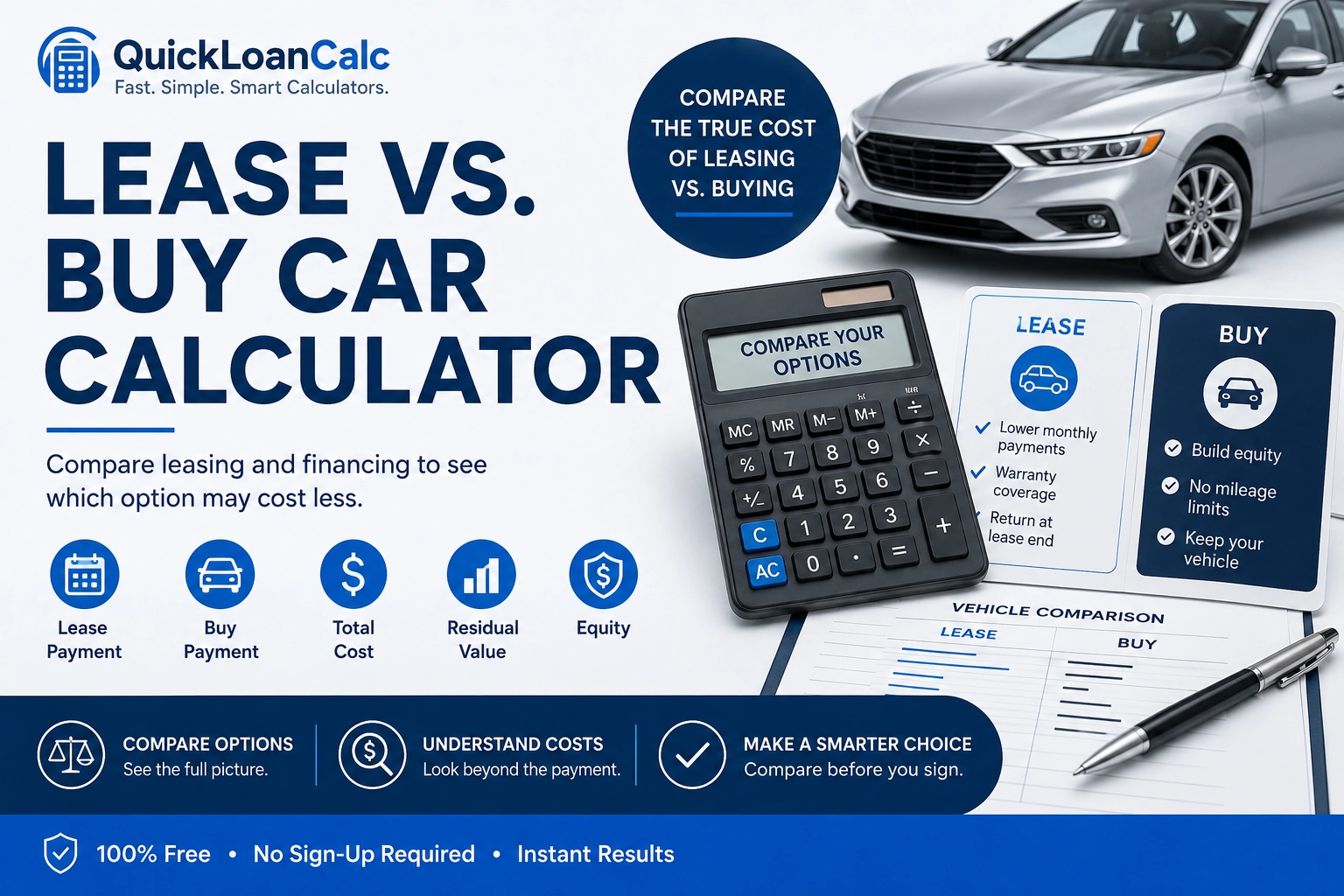
Which Option Could Cost You Less?
Choosing whether to lease or buy a vehicle is about much more than comparing two monthly payments.
A lease may advertise a lower payment and require less money upfront, while financing a vehicle may cost more each month but allow you to build ownership in something that could still have value years later. Both options can make sense depending on the vehicle, your driving habits, your finances, how long you plan to keep the car, and the terms being offered.
The QuickLoanCalc Lease vs. Buy Car Calculator is designed to help you look beyond the advertised payment and compare the estimated financial cost of both options over the same period of time.
Instead of asking only:
“Which payment is lower?”
the better question is:
“Which option may cost me less after everything is considered?”
That distinction matters.
When you buy a vehicle with financing, your monthly payment includes principal and interest. As you make payments, you gradually reduce the loan balance and build equity in the vehicle. At the end of the comparison period, you may still owe money on the loan, but you also own a vehicle that has an estimated resale value.
A lease works differently.
Your monthly lease payment generally reflects the vehicle’s expected depreciation during the lease period along with a financing charge. At the end of most leases, you return the vehicle unless you choose to purchase it under the terms of the lease agreement.
That means comparing a five-year car loan directly against a three-year lease simply by adding up monthly payments can produce a misleading result.
QuickLoanCalc takes a different approach.
Our calculator compares the estimated cost of leasing and buying over the same comparison period. For the buy option, it considers the remaining loan balance and the estimated value of the vehicle at the end of that period. For the lease option, it can account for factors such as residual value, money factor, acquisition fees, disposition fees, mileage limits, and potential excess-mileage charges.
This gives you a much broader picture of the transaction.
For example, imagine you’re considering a $40,000 vehicle.
The finance offer might be:
$5,000 down
7% APR
60-month loan
The lease offer might be:
36 months
60% residual value
Money factor of 0.00250
$2,000 capital-cost reduction
12,000 miles per year
Simply comparing the monthly payments doesn’t tell you which option is financially stronger.
The lease may have the lower monthly payment.
But after 36 months, the buyer may have accumulated thousands of dollars in vehicle equity while the lessee may return the vehicle with no ownership value.
On the other hand, the lease may protect the driver from some of the long-term depreciation and resale uncertainty associated with owning the vehicle.
Neither option automatically wins.
That is why this calculator asks for more information than a basic payment calculator.
When Comparing a Lease and Purchase, Look at the Complete Deal
Important numbers may include:
- Vehicle MSRP
- Negotiated selling price
- Purchase down payment
- Loan interest rate
- Loan term
- Lease term
- Residual percentage
- Money factor
- Capital-cost reduction
- Acquisition fee
- Disposition fee
- Annual mileage allowance
- Expected mileage
- Excess-mileage charge
- Estimated vehicle value at the end of the comparison period
Each of these can influence the result.
A lease that initially appears inexpensive may become less attractive if you drive considerably more than the mileage allowance.
A purchase with a high monthly payment may become more attractive when the remaining vehicle value is considered.
A large lease down payment may reduce the advertised monthly payment but requires more cash upfront.
A high loan interest rate may make financing considerably more expensive than the vehicle’s selling price suggests.
The goal of QuickLoanCalc is not to tell you that leasing is always better or that buying is always smarter.
The goal is to give you the numbers so you can understand the tradeoff.
Use the Calculator Before You Negotiate
The best time to compare lease and purchase options is before you’re sitting in the finance office.
Enter the numbers you’re being offered.
Then change them.
Try a different loan rate.
Increase or reduce the down payment.
Compare a 36-month lease with a 60-month purchase.
Adjust the expected resale value.
Enter the number of miles you actually expect to drive.
If you’re considering multiple vehicles, compare each one separately.
A few minutes spent testing different scenarios can reveal financial differences that aren’t obvious from the monthly payment alone.
Use the QuickLoanCalc Lease vs. Buy Car Calculator below to compare the estimated cost of both options and decide which structure better fits your plans.
This calculator compares estimated financial cost over the same period as the lease. For the buy option, it accounts for payments made, remaining loan balance, and estimated vehicle resale value. Lease taxes and fees vary by jurisdiction and lender, so actual lease disclosures may differ.
Closing — Lease vs. Buy Car Calculator
Lease or Buy? Look Beyond the Monthly Payment
The decision to lease or buy a vehicle becomes much easier to understand once you stop treating the monthly payment as the entire deal.
A monthly payment answers only one question:
How much money is required this month?
It does not tell you what you will own at the end of the comparison period, how much interest you paid, whether you’ll face mileage charges, how much cash you used upfront, or what the vehicle may still be worth.
Those differences are where the real lease-versus-buy comparison happens.
Buying generally gives you an ownership interest in the vehicle.
As the loan balance declines, you may build equity if the vehicle’s market value remains higher than the amount you still owe. Eventually, once the loan is paid off, you can continue driving the vehicle without a scheduled car payment, sell it, trade it, or keep it as long as you choose.
Leasing generally offers a different set of advantages and responsibilities.
You may receive a newer vehicle more frequently and potentially have a lower monthly payment than a comparable purchase. But leases usually include mileage limits, vehicle-condition requirements, and end-of-lease decisions that don’t apply in the same way when you own the vehicle.
The better option depends on how you actually use a car.
Leasing May Be More Attractive If You:
- Prefer driving a newer vehicle every few years
- Drive a predictable number of miles
- Don’t want to manage long-term resale value
- Prefer a lower short-term monthly payment
- Expect to return the vehicle at the end of the lease
- Are comfortable following mileage and condition requirements
Buying May Be More Attractive If You:
- Keep vehicles for many years
- Drive substantial mileage
- Want to build equity
- Prefer having no mileage restrictions
- Want the option to modify the vehicle
- Plan to eventually eliminate the monthly payment
- Want control over when the vehicle is sold or traded
These are not universal rules.
A strong lease offer can sometimes beat an unattractive financing offer.
A heavily discounted purchase with favorable financing can outperform a lease.
The vehicle itself also matters. Some vehicles retain value better than others, which can influence both lease residuals and long-term ownership economics.
That’s why the numbers should be compared each time.
Be Careful With Money Down on a Lease
One area that deserves particular attention is the amount due upfront.
A larger capital-cost reduction may make a lease payment look considerably lower.
But you’re still spending the money.
When comparing lease offers, look at both:
Monthly payment
and
Total amount paid over the lease
A lease advertised at $499 per month with several thousand dollars due at signing may not be as inexpensive as the monthly payment initially suggests.
The same principle applies to financing.
A large down payment can reduce the loan balance and monthly payment, but it also requires more cash upfront.
QuickLoanCalc helps you put those amounts back into the comparison.
Mileage Can Change the Lease Equation
Mileage is another major difference between leasing and buying.
If your lease allows 12,000 miles per year and you consistently drive 18,000 miles, excess-mileage charges can become significant by the end of the term.
A purchased vehicle does not normally impose a contractual mileage penalty.
Higher mileage can reduce resale value, but you aren’t charged a predetermined amount for exceeding a mileage allowance.
If you’re unsure how much you drive, look at your recent odometer history before entering the expected mileage.
Being realistic gives you a much more useful comparison.
Consider What Happens After the Comparison Period
A lease commonly ends with a decision:
Return the vehicle.
Purchase it.
Or replace it with something else.
Buying creates a different decision.
You may still have a loan balance, but you also have a vehicle with market value.
This is why the QuickLoanCalc comparison includes estimated vehicle equity rather than simply totaling purchase payments.
If you want to estimate what the vehicle may be worth later, use the Vehicle Value Calculator to examine depreciation, mileage, condition, and estimated remaining value.
If you’re financing instead of leasing, you can also use the Auto Loan Interest Calculator to see how much of your repayment may go toward interest.
And if you’re trying to determine what payment fits your budget before choosing a vehicle, use the Car Affordability Calculator.
Before You Lease or Buy, Check the Vehicle
Financial terms tell you what the transaction may cost.
They don’t tell you everything about the vehicle itself.
Before buying a used vehicle or purchasing a leased vehicle at the end of its term, verify the VIN and make sure the vehicle information matches what you’re expecting.
Check the vehicle VIN with VinFrenzy.com →https://vinfrenzy.com
Knowing the financing is important.
Knowing the vehicle is equally important.
The Bottom Line
There isn’t a universal answer to:
“Should I lease or buy?”
The right answer depends on the vehicle, terms, interest rate, mileage, depreciation, ownership period, and your personal priorities.
What you should avoid is making the decision from one number.
Don’t compare:
$550 lease payment
against:
$700 loan payment
and assume the lease is automatically $150 cheaper.
Compare the complete financial picture.
Look at:
Cash paid upfront
Monthly payments
Interest
Fees
Mileage costs
Remaining loan balance
Vehicle value
Equity
Total estimated cost
Then decide.
QuickLoanCalc exists to help you see those numbers before you commit.
Compare first. Sign second.
Related QuickLoanCalc Tools
Car Loan Calculator → Car Loan Calculator
Compare different loan amounts, rates, and terms.
Car Affordability Calculator → Can I Afford This Car
Estimate how much vehicle may fit your monthly budget.
Down Payment Calculator → Down Payment Calculator
See how putting additional money down affects your financing.
Auto Loan Interest Calculator → Auto Loan Interest Calculator
Compare the interest cost of different rates.
All Car Loan Calculators → Car Loan Calculators
Explore all QuickLoanCalc auto-financing calculators.
Explore QuickLoanCalc’s complete collection of auto financing tools.