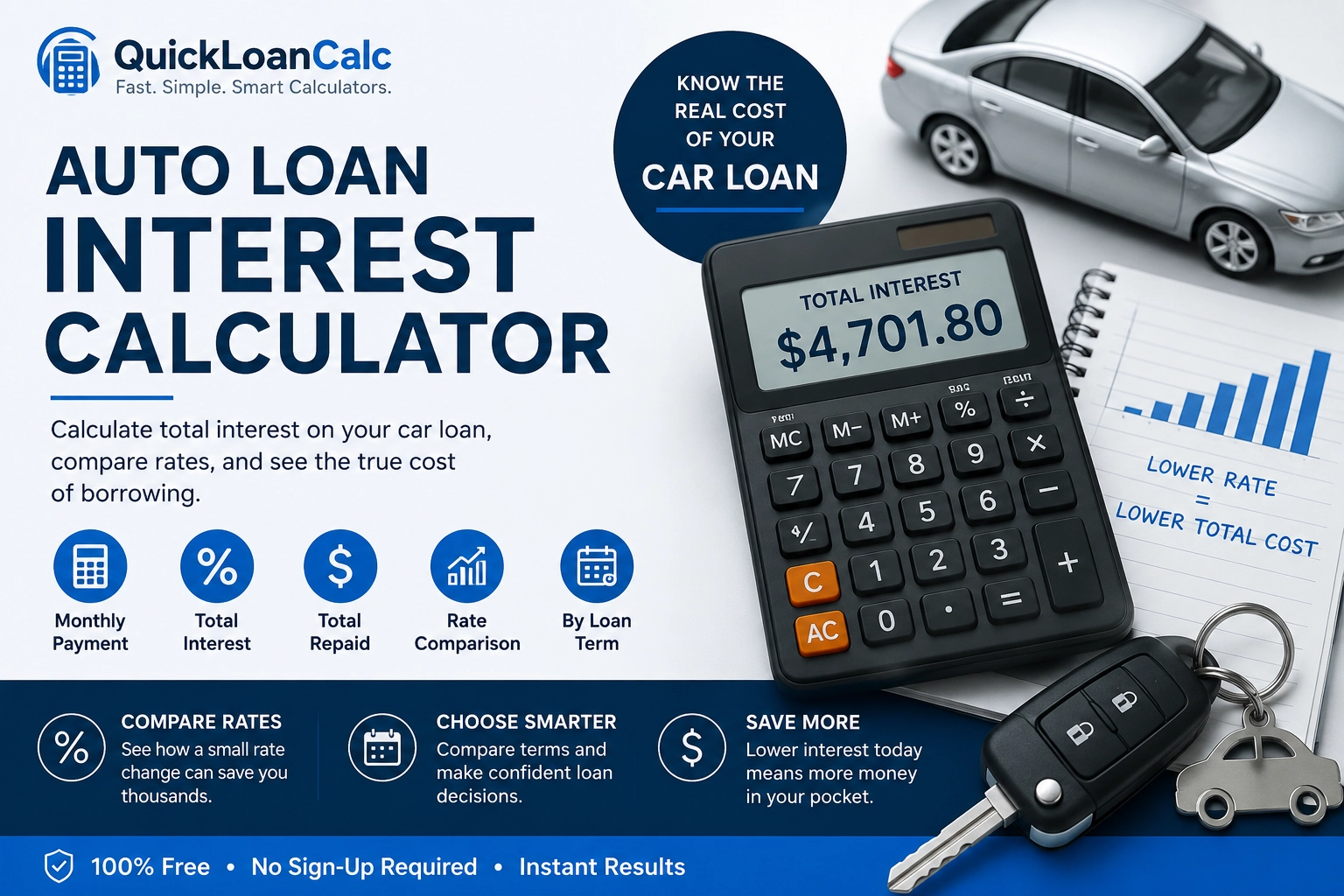
How much interest will you actually pay on your car loan?
Use the QuickLoanCalc Auto Loan Interest Calculator to estimate your monthly payment, total interest, total amount repaid, and how much of your loan cost comes from interest.
Enter the amount you plan to finance, your annual interest rate, and your loan term.
The calculator will show not only your monthly payment, but the amount of money you may pay above the amount originally borrowed.
That number can make a major difference when comparing auto loans.
Calculate Your Auto Loan Interest
How a Different Interest Rate Changes the Loan
| Interest Rate | Monthly Payment | Total Interest | Total Repaid |
|---|
Estimates assume a fixed-rate amortizing auto loan with equal monthly payments. Actual lender figures may differ because of fees, payment timing, rounding, taxes, insurance, optional products, or other loan terms.
Change the loan amount, interest rate, or loan term to compare different financing options.
Pay particular attention to:
Total Interest Paid
That number represents the estimated cost of borrowing the money over the full scheduled loan term.
How Much Interest Will I Pay on My Car Loan?
The total interest on an auto loan depends primarily on three things:
- How much you borrow
- Your interest rate
- How long you take to repay the loan
Borrowing more money generally means paying more interest.
A higher interest rate increases the cost of borrowing.
And a longer loan term gives interest more time to accumulate.
That means two people can buy vehicles with the same amount financed but pay very different amounts by the time their loans are finished.
Example: $25,000 Car Loan at 7% for 60 Months
Suppose you finance:
Amount financed: $25,000
Interest rate: 7%
Loan term: 60 months
The estimated monthly payment is:
$495.03
Over five years, the estimated total amount repaid is:
$29,701.80
Estimated total interest:
$4,701.80
In other words, you borrowed:
$25,000
but approximately:
$29,702
leaves your pocket through scheduled loan payments.
The difference is the interest cost.
In this example, the total interest is approximately:
18.8% of the original amount borrowed
That does not mean the annual interest rate is 18.8%.
It means that over the full five-year repayment period, the accumulated interest equals approximately 18.8% of the original $25,000 principal.
How Is Car Loan Interest Calculated?
Most standard fixed-rate auto loan estimates use an amortization calculation.
The monthly payment can be estimated with this formula:
M = P × [r(1+r)ⁿ] ÷ [(1+r)ⁿ − 1]
Where:
M = monthly payment
P = principal or amount financed
r = monthly interest rate
n = number of monthly payments
Once the estimated monthly payment is known:
Total of Payments = Monthly Payment × Number of Payments
Then:
Total Interest = Total of Payments − Amount Borrowed
QuickLoanCalc performs these calculations automatically.
Why Do You Pay More Interest at the Beginning of a Car Loan?
On a typical amortizing loan, interest is calculated using the remaining principal balance.
At the beginning of the loan, your outstanding balance is at its highest.
That means the interest portion of the payment is also generally highest near the beginning.
As principal is paid down, the outstanding balance becomes smaller.
Less interest is then generated.
For example, on a $25,000 loan at 7%:
The estimated interest included in the first month’s payment is approximately:
$145.83
Near the end of the same 60-month loan, the interest portion of the final scheduled payment is only a few dollars.
The monthly payment may remain approximately the same, but the way that payment is divided between principal and interest changes over time.
Interest Rate Can Change the Cost of the Same Car Dramatically
Consider financing:
$25,000 for 60 months
At different interest rates:
| Interest Rate | Monthly Payment | Total Interest |
|---|---|---|
| 5% | $471.78 | $3,306.85 |
| 7% | $495.03 | $4,701.80 |
| 9% | $518.96 | $6,137.53 |
| 15% | $594.75 | $10,684.90 |
The vehicle didn’t change.
The amount borrowed didn’t change.
The loan term didn’t change.
Only the interest rate changed.
Yet the estimated difference in interest between 5% and 15% is more than:
$7,300
That’s why comparing rates can be every bit as important as negotiating the vehicle’s purchase price.
Internal link: Link compare car loan payments and rates to your main Car Loan Calculator.
A Small Interest Rate Difference Can Still Matter
Imagine receiving two loan offers on $25,000 for 60 months.
Loan A
Interest rate:
7%
Monthly payment:
$495.03
Total interest:
$4,701.80
Loan B
Interest rate:
9%
Monthly payment:
$518.96
Total interest:
$6,137.53
The monthly payment differs by only about:
$23.93
That might not seem significant while you’re buying the vehicle.
But over five years, the higher-rate loan costs approximately:
$1,435.73 more in interest
Monthly-payment differences can look small while the long-term difference is much larger.
Does a Longer Car Loan Mean More Interest?
Generally, yes, when comparing the same amount financed at the same interest rate.
A longer loan spreads the principal across more monthly payments.
That typically lowers the required monthly payment.
But because the balance is outstanding longer, the total interest usually increases.
For example, suppose you finance $25,000 at 7%.
A shorter term will generally produce:
Higher monthly payments
but:
Lower total interest
A longer term will generally produce:
Lower monthly payments
but:
Higher total interest
That’s why QuickLoanCalc displays both numbers.
You shouldn’t have to choose a loan while looking at only half the equation.
Monthly Payment vs. Total Interest
These two numbers answer different questions.
Monthly Payment
Answers:
“How much do I need to pay each month?”
Total Interest
Answers:
“How much is borrowing this money costing me?”
Both matter.
A loan can have an affordable monthly payment while still carrying a high total financing cost.
This becomes especially important with 72-month and 84-month vehicle loans.
The payment may look much easier to manage because it is spread across six or seven years.
But the total borrowing cost can increase substantially.
What Does “Amount Financed” Mean?
The amount financed is the principal balance of your loan.
It is not necessarily the same as the advertised price of the vehicle.
For example:
Vehicle price:
$30,000
Down payment:
$5,000
Before taxes and other adjustments, the amount remaining could be:
$25,000
But the actual amount financed may also be affected by:
- Sales tax
- Trade-in value
- Negative equity
- Title fees
- Registration
- Dealer fees
- Warranties
- Service contracts
- Other financed products
When using the Auto Loan Interest Calculator, enter the amount you expect to actually finance whenever possible.
Does a Down Payment Reduce Car Loan Interest?
Generally, yes.
A down payment reduces the amount that must be financed.
If you borrow less money, there is less principal generating interest.
For example:
Instead of financing:
$25,000
you might make a $5,000 down payment and finance:
$20,000
Assuming the same rate and term, the smaller loan generally produces both:
A lower monthly payment
and:
Less total interest
If your QuickLoanCalc Down Payment Calculator is live, link see how a down payment changes your car loan to that calculator here.
Can a Trade-In Reduce Interest?
A trade-in with positive equity can reduce the amount that needs to be financed.
That can reduce both the loan payment and total interest.
However, a trade-in with negative equity can have the opposite effect.
For example:
Vehicle trade value:
$10,000
Amount still owed:
$13,000
Negative equity:
$3,000
If that $3,000 is added to your next financing agreement, your new loan balance may become larger.
A higher principal means more money may be subject to interest.
How Can You Pay Less Interest on a Car Loan?
Several changes can potentially reduce total interest.
Borrow Less
A larger down payment or less expensive vehicle can reduce the amount financed.
Get a Lower Interest Rate
Comparing financing offers can make a meaningful difference over a multi-year loan.
Choose a Shorter Loan Term
A shorter term generally produces a higher monthly payment but lower total interest when other terms remain equal.
Avoid Financing Unnecessary Add-Ons
Optional products added to the loan increase the principal.
If they are financed, you may also pay interest on those products.
Pay Additional Principal When Appropriate
Depending on the loan agreement, additional principal payments may shorten the payoff period and reduce interest.
Check your lender’s terms before assuming how extra payments will be applied.
Why Comparing Interest Matters Before Buying the Car
Many vehicle transactions are discussed primarily in terms of monthly payment.
You may hear:
“We can get this down to $499 a month.”
But a monthly payment by itself doesn’t tell you:
- Amount financed
- Interest rate
- Loan length
- Total interest
- Total repayment cost
A $499 payment for four years and a $499 payment for seven years are very different financial commitments.
Before signing, look beyond:
“Can I afford the payment?”
Also ask:
“How much is this financing costing me?”
Use the Rate Comparison
The QuickLoanCalc Auto Loan Interest Calculator automatically compares the interest rate you enter with rates approximately two percentage points lower and two percentage points higher.
This can help illustrate how much a rate change affects:
- Monthly payment
- Total interest
- Total repayment
For example, if your quoted rate is 9%, compare it against approximately 7% and 11%.
You may discover that what looks like a relatively small rate difference can become a meaningful amount of money across 60, 72, or 84 payments.
Questions to Ask Before Accepting an Auto Loan
Before signing the financing agreement, identify:
What is my actual amount financed?
Look beyond the advertised vehicle price.
What is my interest rate?
Know the rate being applied to your balance.
What is the APR?
Review the APR disclosed by the lender.
How long is the loan?
Know exactly how many scheduled payments are required.
What is my monthly payment?
Make sure the required payment fits your budget.
What is my total interest?
Understand the cost of borrowing.
What is the total of payments?
Know how much you’re scheduled to repay altogether.
Were optional products financed?
Review warranties, protection plans, service agreements, and other additions individually.
Frequently Asked Questions
How much interest will I pay on my car loan?
It depends on the amount financed, interest rate, and loan term.
For example, $25,000 financed at 7% for 60 months produces approximately $4,701.80 in estimated total interest.
How do I calculate total interest on an auto loan?
For a standard amortizing loan, an estimate can be calculated by multiplying the monthly payment by the total number of payments and subtracting the original principal.
Total Interest = Total Scheduled Payments − Principal
The calculator above performs the calculation automatically.
Does a higher interest rate increase my car payment?
Yes, when other loan terms remain the same.
A higher interest rate generally increases both the monthly payment and total amount of interest paid.
Does a longer car loan increase total interest?
Generally, yes.
A longer term typically lowers the monthly payment but increases total interest because the loan remains outstanding longer.
Does making a down payment reduce interest?
Generally, yes.
A down payment reduces the amount financed. A smaller principal normally results in less total interest when the interest rate and loan term remain the same.
Is APR the same as the interest rate?
Not always.
The stated interest rate reflects the rate charged on the loan balance, while APR can incorporate certain additional financing costs according to the loan terms and applicable disclosures.
Review both when comparing lender offers.
Why is more of my payment interest at the beginning?
Interest is generally calculated against the outstanding principal balance.
Because the balance is highest near the beginning of the loan, the interest portion of early payments is typically larger.
As the principal balance declines, the interest portion generally becomes smaller.
Is QuickLoanCalc a lender?
No.
QuickLoanCalc.net provides calculators and educational information.
QuickLoanCalc does not approve, broker, originate, or fund auto loans.
Know the Cost of the Money — Not Just the Cost of the Car
A vehicle may cost:
$20,000
$25,000
$30,000
or more.
But the price on the vehicle isn’t necessarily the amount you ultimately pay.
Financing has a cost.
The interest rate and loan term determine how much additional money may be paid for the ability to borrow.
Use the Auto Loan Interest Calculator to compare:
Monthly payment
Total interest
Total repayment
Different interest rates
before accepting financing.
Knowing the payment tells you what the loan costs this month.
Knowing the total interest tells you what the loan may cost you over its entire life.
Related QuickLoanCalc Tools
Car Loan Calculator → Car Loan Calculator
Compare different loan amounts, rates, and terms.
Car Affordability Calculator → Can I Afford This Car
Estimate how much vehicle may fit your monthly budget.
Down Payment Calculator → Down Payment Calculator
See how putting additional money down affects your financing.
Auto Loan Interest Calculator → Auto Loan Interest Calculator
Compare the interest cost of different rates.
All Car Loan Calculators → Car Loan Calculators
Explore all QuickLoanCalc auto-financing calculators.
Before You Buy, Check the VIN
A VIN can help verify important identifying information about the vehicle before you complete a purchase or financing agreement.
➡️ Check the vehicle VIN with VinFrenzy.com
Financing tells you what the money may cost.
Checking the VIN helps you learn more about the vehicle you’re financing.
Important Information
QuickLoanCalc.net provides calculators and educational information for general informational purposes only.
Calculator results are estimates and may differ from actual lender figures because of payment timing, rounding, fees, taxes, insurance, financing structure, lender requirements, optional products, or other factors.
QuickLoanCalc.net is not a lender, loan broker, financial advisor, legal advisor, or tax advisor.
Always review the official lender disclosures and financing agreement before entering into a loan.
Last reviewed: September 2026